


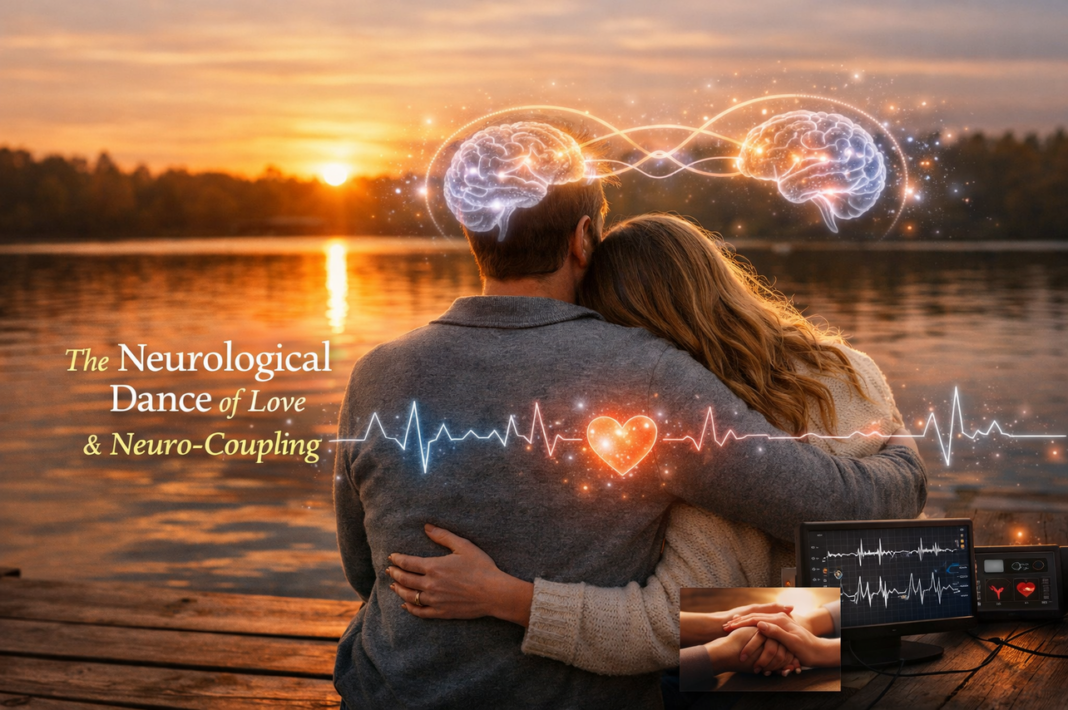

Sometimes we find ourselves becoming strangely calm around certain people. You sit next to someone, and even if they don’t say a single word, a quiet sense of ease settles inside you. Your heart rate slows down, your breath finds a steady rhythm, and the noise in your mind begins to fade. It feels as if the person beside you is radiating an invisible kind of emotional weather. But why does this experience happen only with some people and not others? Why do certain relationships make us feel safer, more grounded, and more whole? Neuroscience offers a new explanation: neuro-coupling — the process in which two people’s nervous systems attune to one another and begin to operate in a shared rhythm.
The Invisible Bond: Co-Regulation
In modern relationships, there is a phrase we hear quite often: “Even when we argue, I still feel calm with them.” This surprising statement is actually the everyday expression of something known as co-regulation — a process in which two people’s emotional systems begin to attune to one another. Co-regulation means that:
-
When your partner is anxious, your nervous system can naturally create a calming effect,
-
The quiet that follows an argument is not just emotional—it’s actually a synchronization of brain waves,
-
Feeling peaceful with one person and tense with another is not a coincidence but a biologically grounded phenomenon.
A long-term study by Helm, Sbarra, and Ferrer (2012) showed that romantic partners’ heart rhythms naturally synchronize over time. In other words, calming down together is not merely a metaphor — it is a physiological reality.
Emotional Regulation Capacity: The Heart Of Neuro-Coupling
Not everyone can regulate their emotions with the same ease. Some people, even when faced with internal storms, manage to remain centered and calm. As Bowlby (1988) highlighted in attachment theory, the connection a person maintains with their own emotional world is a fundamental factor in the sense of security they bring to a relationship. When you are close to such a partner, their calm presence becomes noticeable even during crises: their tone of voice is soothing, their presence establishes a regulating rhythm, and they can carry emotional intensity without being overwhelmed. The pace of the relationship becomes more predictable and easier to navigate.
In contrast, relationships with partners who have weaker emotional regulation are far more turbulent. Even small triggers can provoke intense stress responses, tension spreads quickly, and moments of closeness may be met with withdrawal or emotional overflow. In these cases, conflicts are less about disagreements and more about the clashing of nervous systems. This is precisely what determines whether neuro-coupling occurs. Two people’s nervous systems can only align to a shared rhythm if each individual can genuinely access their own internal rhythm. Someone who cannot regulate their own emotions cannot be expected to regulate their partner’s. Co-regulation is not a one-sided effort—it is a delicate dance in which two nervous systems move toward each other in synchrony.
The “Emotional Rain” Effect: Shared Traits Of Soothing Individuals
Some people have a truly “rain-like” effect on those around them. Their nervous system helps us shift from a fight-or-flight state into a secure attachment mode, creating a sense of safety and calm. Certain traits are commonly observed in these individuals:
-
A high capacity for empathy,
-
A soft tone of voice with a steady rhythm,
-
Body posture that conveys no threat,
-
An attitude that prioritizes connection even during conflict.
Physiological research supports these observations. For instance, Goldstein et al. (2018) found that partners’ brain waves synchronize when they hold hands. Similarly, Levenson & Gottman (1983) demonstrated that couples’ skin conductance and physiological arousal levels mirror each other. Individuals who bring calm do more than soothe emotionally—they exert a biological regulatory influence as well.
So, Why Isn’t Every Relationship Like This?
Neuro-coupling is not about chemistry; it is a neurological attunement process. It does not occur in certain situations:
-
When one partner is constantly on edge or in a state of hypervigilance,
-
When an avoidant attachment style prevents emotional closeness,
-
When an individual carries a dysregulated nervous system from childhood,
-
When the relationship is built on uncertainty rather than trust.
In some relationships, love is abundant, passion is high, and excitement is intense… yet the nervous systems may never align in the same rhythm.
What Changes When Neuro-Coupling Occurs?
These kinds of bonds are rare, but they run deep. Observed effects include:
-
Conflicts become regulatory rather than destructive,
-
A partner’s voice can reduce anxiety by 30–40% (Seltzer et al., 2010),
-
Touch activates the vagus nerve, providing chemical relaxation to the body,
-
Couples develop the ability to calm down together,
-
Individuals become their most secure and regulated selves in the presence of their partner.
This goes beyond romantic intimacy—it is the brain orchestrating two people as a single system.
Conclusion
Romance is often celebrated in modern relationships, but perhaps the real power lies in two people’s ability to regulate each other’s nervous systems. Some people enter our lives like a storm… yet only a rare few become an emotional rain, offering calm at the most unexpected moments. Perhaps true connection is not built between two hearts, but between two nervous systems.
References
Bowlby, J. (1988). A secure base: Parent-child attachment and healthy human development. Basic Books. Goldstein, P., Weissman-Fogel, I., Dumas, G., & Shamay-Tsoory, S. G. (2018). Brain-to-brain coupling during handholding is associated with pain reduction. Proceedings of the National Academy of Sciences of the United States of America, 115(11), E2528–E2537. https://doi.org/10.1073/pnas.1703643115 Helm, J. L., Sbarra, D., & Ferrer, E. (2012). Assessing cross-partner associations in physiological responses via coupled oscillator models. Emotion (Washington, D.C.), 12(4), 748–762. https://doi.org/10.1037/a0025036 Levenson, R. W., & Gottman, J. M. (1983). Marital interaction: physiological linkage and affective exchange. Journal of personality and social psychology, 45(3), 587–597. https://doi.org/10.1037//0022-3514.45.3.587 Seltzer, L. J., Ziegler, T. E., & Pollak, S. D. (2010). Social vocalizations can release oxytocin in humans. Proceedings. Biological sciences, 277(1694), 2661–2666. https://doi.org/10.1098/rspb.2010.0567