


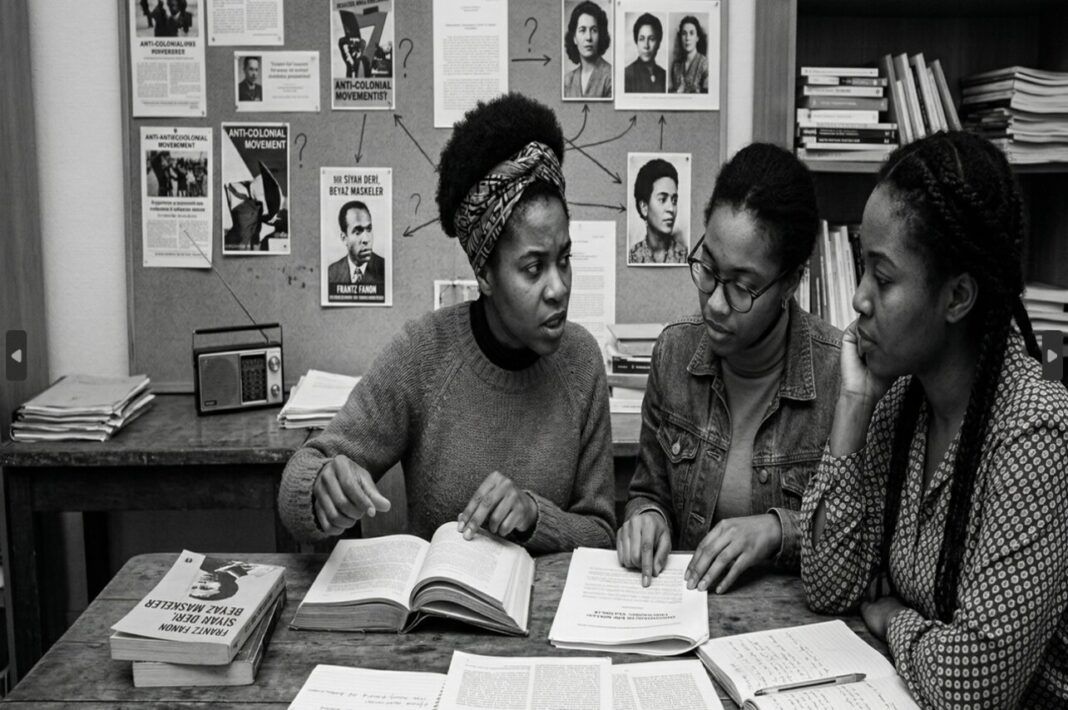

Frantz Fanon remains one of the most electrifying thinkers of the twentieth century. His two highly acclaimed books, Black Skin, White Masks (1952) and The Wretched of the Earth (1961), gave the world a psychologically sophisticated account of colonialism’s damage to the human mind. Fanon understood how colonial systems not only impoverish and exploit colonial subjects but also deform their identity and self-perception. His work has been indispensable for generations of scholars, especially for those who have been working at the intersection of psychology and politics. And yet, feminist critics have long argued that Fanon’s liberatory vision contained a profound internal contradiction: it freed one group while implicitly subordinating another.
The Inferiority Complex and Its Gendered Blind Spot
At the core of Black Skin, White Masks is Fanon’s analysis of the inferiority complex imposed upon Black individuals by the enforced supremacy of the White world. He traces how this psychic wound operates differently across gender lines, and yet, when it comes to active resistance against colonial oppression, his framework narrows dramatically. The Black man is the subject of liberation; his confrontation with the colonial order is treated as the central, necessary clash. The Black woman, by contrast, is largely absent from this drama of resistance.
This absence is not incidental. It reflects a deeper structural problem in how Fanon frames the colonial subject. Throughout Black Skin, White Masks, as scholar Gwen Bergner (1995) has argued, “women are considered as subjects almost exclusively in terms of their sexual relationships with men; feminine desire is thus defined as an overly literal and limited (hetero)sexuality.” The Black woman appears, when she appears at all, primarily as a figure defined by her desires for men rather than as an autonomous agent navigating her own encounter with colonial power. Nowhere is this more visible than in Fanon’s reading of Mayotte Capécia, a moment that crystallizes both the reach and the limits of his analytical framework.
The Case Of Mayotte Capécia
Fanon’s treatment of writer Mayotte Capécia offers a telling illustration of these limitations. In one of the rare moments where a Black woman is shown in an act of resistance, Capécia recalls a childhood incident in which she seized her inkwell and hurled it at a White classmate, hoping to darken him, to make him more like her. It is a small act of defiance, a child’s attempt to invert the hierarchy of the colonial world using the only power available to her.
But Fanon reads this incident differently. Rather than recognizing the gesture as an expression of resistant consciousness bounded by circumstance, he immediately pivots. He argues that Capécia “realizes early on how vain her efforts were … so, unable to blacken or negrify the world, she endeavors to whiten it in her body and mind” (Fanon, 1952). Her moment of agency is reframed as a precursor to assimilation, her childhood defiance absorbed into a narrative of desire for Whiteness. Myriam Chancy has argued pointedly that Fanon explicitly overlooks the complexities of Capécia’s own writing in reaching this conclusion. His interpretation is selective in ways that serve his theoretical purposes rather than doing justice to the woman herself.
A Framework In Need Of Expansion
What Fanon’s analysis ultimately cannot accommodate is the reality of layered, intersecting oppressions. Black women under colonialism do not only experience racial subjugation; they experience that subjugation compounded by patriarchal structures. Fanon’s framework captures one axis of this experience with considerable power, but it flattens the rest.
Bergner’s (1995) observation cuts to the heart of the matter: “though feminine subjectivity clearly deserves broader description, the dimensions of its confinement within Black Skin, White Masks indicate the architecture of raced masculinity and femininity in the colonial context.” In other words, Fanon’s silences reveal the gendered blind spots that even his liberatory project could not escape.
This is not to diminish Fanon’s extraordinary contribution. His works remain indispensable for understanding Black bodily ontology and the psychic dimensions of colonial domination. As Bergner notes, Fanon “de-essentializes both race and psychoanalytic models of subject formation,” transforming psychoanalysis into a tool for evaluating relations of power and cultural hegemony. That achievement stands. But an achievement is not above critique, and it is precisely because Fanon’s project matters that its limitations must be named.
Conclusion
With the development of intersectionality as both a concept and an analytical framework, the incompleteness of Fanon’s liberatory vision becomes impossible to overlook. His theory of Black liberation centers the Black man’s confrontation with the colonial order, but it relegates the experiences of Black women to the periphery. It defines them through their sexuality and dismisses their acts of resistance. Informed by the limitations of his time, Fanon fails to account for the distinct and intersecting oppressions Black women face, leaving his framework unable to speak to the totality of the Black experience.
With this, it becomes evident that to honor Fanon is not simply to cite him, but to extend and challenge him. To truly grasp the psychic damage colonialism inflicts upon Black people is to confront the full architecture of that damage in all its intersecting dimensions, and to insist that liberation, if it means anything at all, must encompass every subject the colonial world has marked.
References
Bergner, G. (1995). Who is that masked woman? Or, the role of gender in Fanon’s Black Skin, White Masks. PMLA, 110(1), 75–88. https://doi.org/10.2307/463196
Chancy, M. J. A. (1997). Framing silence: Revolutionary novels by Haitian women. Rutgers University Press.
Fanon, F. (1952). Black skin, white masks. Grove Press.
Fanon, F. (1961). The wretched of the earth. Grove Press.