



There is a concept known as the cycle of grief, which appears in both folk psychology and the psychological literature. In On Death and Dying (1969), Elisabeth Kübler-Ross described the stages of grief—denial, anger, bargaining, depression, and acceptance—based on interviews with terminally ill patients rather than bereaved individuals. Thus, the model was initially concerned with people confronting their own death rather than the loss of a loved one. However, Kübler-Ross later conceptualized grief as a response to losing something significant and clarified that the stages may apply to many forms of loss, such as the loss of health or bodily function, loss of identity or social role (e.g., disability or infertility), divorce or romantic breakups, and job loss (Kübler-Ross & Kessler, 2005).
In this paper, I aim to illustrate the cycle of grief through the plot of the film Sound of Metal (2019), directed by Darius Marder. The film centers on Ruben Stone, a former addict and heavy-metal drummer who lives and tours in an RV with his girlfriend and bandmate, Lou. During a tour, Ruben suddenly begins to lose his hearing. Initially, he becomes anxious about the buzzing and distorted sounds he experiences but attempts to hide his symptoms while trying to understand what is happening. Soon, medical professionals confirm that he is experiencing rapid and severe hearing loss, likely permanent. This diagnosis profoundly disrupts his sense of identity, which is closely tied to music and drumming.
Despite the audiologist’s advice to avoid exposure to loud sounds, Ruben continues to perform in noisy concerts. This behavior reflects a common human desire to maintain normality—to act as though nothing is wrong and to continue life unchanged. At this stage, signs of denial become apparent. His decision worsens his condition, reducing his hearing level from approximately 20% to complete deafness unless he can afford cochlear implant surgery. This represents a clear example of a significant loss, which can be understood either as the loss of something tangible, such as a bodily function, or, more abstractly, as a loss of identity.
At first, Ruben is unable to come to terms with his hearing loss. Concerned about his mental health and risk of relapse, Lou arranges for him to stay in a deaf recovery community. At this point, anger and bargaining emerge. Ruben attempts to negotiate with his condition and maintain his former routine. The film effectively captures his underlying aggression, which is often expressed indirectly rather than openly. For example, in one scene, he violently crushes a scone and shouts uncontrollably. This moment can be interpreted as an expression of anger within his grieving process.
Although it is tempting to pinpoint specific stages of grief throughout Ruben’s experience, Kübler-Ross emphasized that individuals do not move through these stages in a linear or uniform manner. People may skip stages, return to earlier ones, experience multiple stages simultaneously, or never experience certain stages at all. From this perspective, Ruben appears to experience denial, anger, bargaining, and depression concurrently. At times, he also exhibits moments of emotional relief or calm, which may reflect emotional numbness or temporary detachment rather than full acceptance, given his continued resistance to his condition.
Ultimately, Ruben realizes that returning to his former life is no longer possible. He comes to understand that deafness does not have to be experienced as something imposed but can instead be understood as a choice—an idea previously introduced by the community leader and captured in the statement, “Being deaf is not a handicap. Deafness is a state of mind.” In the final scene, Ruben sits in silence, as he was taught in the community, suggesting a moment of acceptance and inner stillness rather than a return to his former identity.
In conclusion, the stages of grief offer valuable insight and can serve as a guide through the grieving process by normalizing emotional responses to loss. Feelings such as anger and denial are natural reactions when individuals are confronted with difficult and overwhelming situations. As Kübler-Ross poignantly states in On Grief and Grieving (2005), “There is no correct way or time to grieve.”
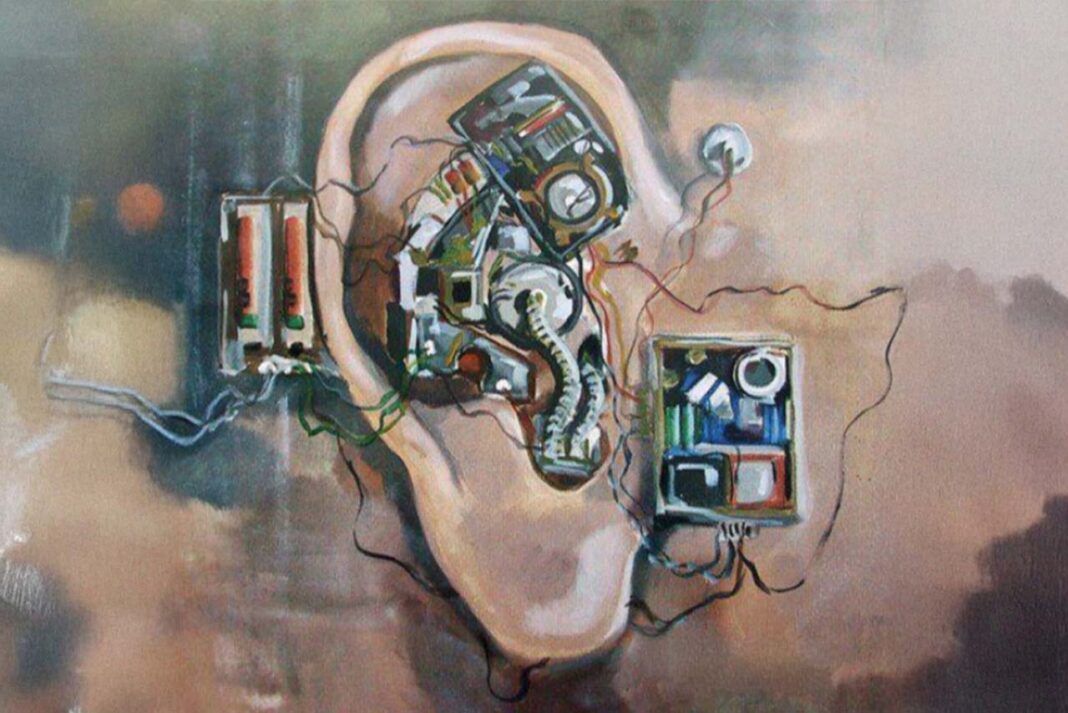
-Mechanical Ear by Chuck Baird: This shows the Deaf Culture’s aversion to hearing aids and cochlear implants-
References
Kübler-Ross, E., & Kessler, D. (2005). On grief and grieving: Finding the meaning of grief through the five stages of loss. Scribner.
Marder, D. (Director). (2019). Sound of metal [Film]. Caviar; Emu Films; Flat Seven Productions.
Baird, C. (1973). Mechanical ear [Drawing]. Sepulveda Unitarian Universalist Society.