


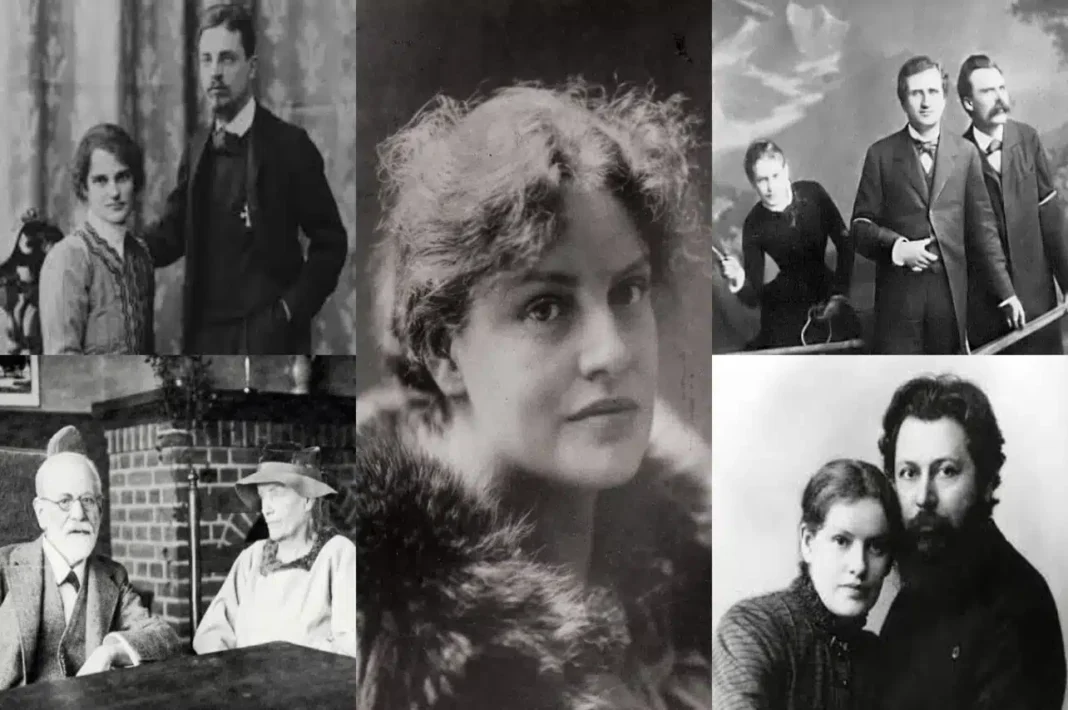

Born in 1861 in St. Petersburg, Salomé experienced an intense inner confrontation with existential questions from an early age. She came from a German-origin military–bureaucratic elite family within the Russian Empire. At a time when women’s access to formal academic education was severely restricted, she received a private education, encountered foreign languages early, and gained access to European intellectual circles. The death of her father, a general, generated both a profound sense of loss and a turn toward metaphysical inquiry. From a psychoanalytic perspective, this period can be interpreted as the beginning of Salomé’s tendency to transform inner conflicts into thought rather than repress them. From a feminist standpoint, this early intellectual solitude represents an initial refusal to define womanhood solely through domestic roles.
Salomé left the church at the age of sixteen, though her interest in theology persisted. At eighteen, she entered her first intimate relationship with the married pastor Hendrik Gillot, who was also her teacher and twenty-five years her senior. This relationship significantly shaped her views on religion. According to Salomé’s later account in Ruth, Gillot fell deeply in love with her and wished to divorce his wife in order to marry her. Salomé refused, and the relationship ended. Seeking education in philosophy, religion, and art history, she moved to Zurich. Due to illness, she was advised to relocate to a warmer climate for treatment, and she traveled to Rome with her mother. There, she met Nietzsche and Paul Rée.
Salomé’s relationship with Nietzsche has often been presented as a dramatic love story. Her rejection of his marriage proposals disrupted prevailing social norms and contributed to her reputation as a “dangerous” woman. She was labeled an “immoral woman” by Nietzsche’s sister. In the fictional novel When Nietzsche Wept, the following line appears: “From which stars did we fall to find each other? What makes such a simple sentence so complex is this woman.” For Salomé, marriage was an institution that constrained women’s intellectual and bodily freedoms. From a psychoanalytic perspective, her refusal can be read as resistance to defining female desire solely through possession. Their relationship later inspired literary representations, including When Nietzsche Wept by Irvin D. Yalom and Nietzsche’s Kisses by Lance Olsen.
In the early 1880s, Salomé formed a close relationship with Rée, which was primarily intellectual and emotional. This relationship, too, ended due to her refusal of marriage. In 1887, she married Friedrich Carl Andreas, maintaining the union for many years as a consciously non-sexual partnership. In her notes, Salomé stated that she refrained from sexual relations until the age of thirty-four. Andreas had threatened suicide if she refused to marry him, which precipitated the marriage. Despite this, Salomé continued to engage in flirtations with other men throughout her life, with her husband’s knowledge, and they remained married until his death.
Among these figures were Rainer Maria Rilke, Victor Tausk, and Friedrich Pineles. Sigmund Freud later remarked that he wished he had more openly expressed his love and admiration for her, while Leo Tolstoy was reportedly deeply impressed upon meeting her.
In her late thirties, Salomé entered a romantic relationship with the much younger Rainer Maria Rilke. Her confidence and intellectual presence profoundly influenced the poet, who described her as his “only reality.” Salomé’s guidance played a crucial role in the transformation of Rilke’s poetic language. Yet this relationship did not produce a self-sacrificing female archetype. Psychoanalytically, Salomé’s ability to sustain intimacy without conflating maternal, sexual, and intellectual roles is particularly striking. From a feminist perspective, the relationship demonstrates that a woman can nurture without erasing herself. However, Rilke developed an almost existential dependence on Salomé, even changing his name from René to Rainer in an effort to appear more “masculine.” Valuing her autonomy, Salomé withdrew when the emotional intensity became overwhelming. The relationship had begun to operate through maternal transference, which Salomé consciously recognized and resisted. Although they separated, they maintained a long-standing correspondence and intellectual friendship. Salomé regarded Rilke as the love of her life until her death, not leaving him out of indifference, but to avoid becoming the woman responsible for his salvation.
In the early twentieth century, Salomé formed close ties with Freud and the psychoanalytic community. Her relationship with Freud was intellectual rather than romantic. Freud described her as possessing a formidable intellect and an unusual freedom from both feminine and general human weaknesses. Salomé became an active contributor to psychoanalysis, particularly in the areas of narcissism, female eroticism, and the formation of the self. She viewed sexuality not merely as a biological phenomenon, but as a creative relationship between the self and the world—an approach that challenged reductive views of female sexuality within classical psychoanalysis.
Her husband died of cancer in 1930. Salomé herself underwent cancer surgery in 1935. Years of emotional distance between them softened somewhat during their final illnesses. She died of uremia in 1937 in Göttingen. Shortly after her death, the Gestapo confiscated her library. Her legacy lives on through institutions and streets bearing her name, including the Lou Andreas-Salomé Institute for Psychoanalysis and Psychotherapy.
Salomé authored fifteen novels and numerous scholarly works, including Ruth (1895), Volga (1902), and Das Haus (1919). Although often remembered for her relationships, her enduring significance lies in her contributions to psychoanalysis, literature, religion, and philosophy, through which she introduced a distinctly female perspective into a male-dominated intellectual tradition.
References
Aruoba, O. (1999). İle. Metis Yayınları.
Andreas-Salomé, L. (1974). Lebensrückblick (Nachtrag, 1934).
Hollingdale, R. J. (1999). Nietzsche: The Man And His Philosophy. Cambridge University Press.
Yalom, I. D. (1999). Nietzsche Ağladığında (Çev. A. Bora). Ayrıntı Yayınları.
Olsen, L. (2007). Nietzsche’nin Öpücükleri (Çev. Işıl Özbek). Versus Kitap.
Roudinesco, E., & Plon, M. (2011). Andreas-Salomé Lou, née Liola (Louise) von Salomé (1861–1937). In Dictionnaire De La Psychanalyse. Fayard.
Freud, S., & Andreas-Salomé, L. (1985). Letters (E. Pfeiffer, Ed.). W. W. Norton & Company.
Arana, R. V. (2008). The Facts On File Companion To World Poetry: 1900 To The Present. Infobase.
Andreas-Salomé, L. (2020). Arayışlar (İlknur İgan, Çev.). İş Bankası Kültür Yayınları.
Andreas-Salomé, L. (2018). Ruth (İlknur İgan, Çev.). İş Bankası Kültür Yayınları.