



Growing is, at first, hurting. — Sylvia Plath, Crossing the Water (1971)
“Childhood is a person’s mainland,” they say. My departure from this imaginary piece of land happened with incredible gentleness. While I used to want to create new continents and islands as soon as possible, I didn’t care much for this lovely piece I had left behind. However, something has changed in me since last year, and I have finally accepted the umbilical cord tied to that mainland. Looking back, the scenes I see mostly consist of moments when I knew my parents were having fun, our nuclear family blending into large groups of relatives or friends. Holidays, birthdays, New Year’s Eves, match and movie nights…
When I got together with my parents last holiday, I thought about how we used to spend holidays. It probably passed in a rush up to a certain point. Until we went to my grandmother’s or great-grandmother’s for the holiday dinner in the evening, I would be hanging out with my cousins or by myself in the houses of our elderly relatives we visited. I would hide my pocket money in the most secret compartment of my bag, count it when I got home, and think about the new toys I wanted to buy. Thus, a few days of holiday break would pass.
The Changing Face Of Holiday Traditions
Like everything else, holidays and our traditions have changed. As the number of people who saw the holiday as an opportunity to go somewhere and take a real vacation instead of visiting houses increased, my portion of the Albanian şekerpare prepared by my grandmother also increased. At that time, the decrease in the number of guests was not something I felt deprived of. In fact, during my adolescence, fewer people would even be pleasing for me. During my university years, the holiday would turn into a gap that I wouldn’t even realize was passing by.
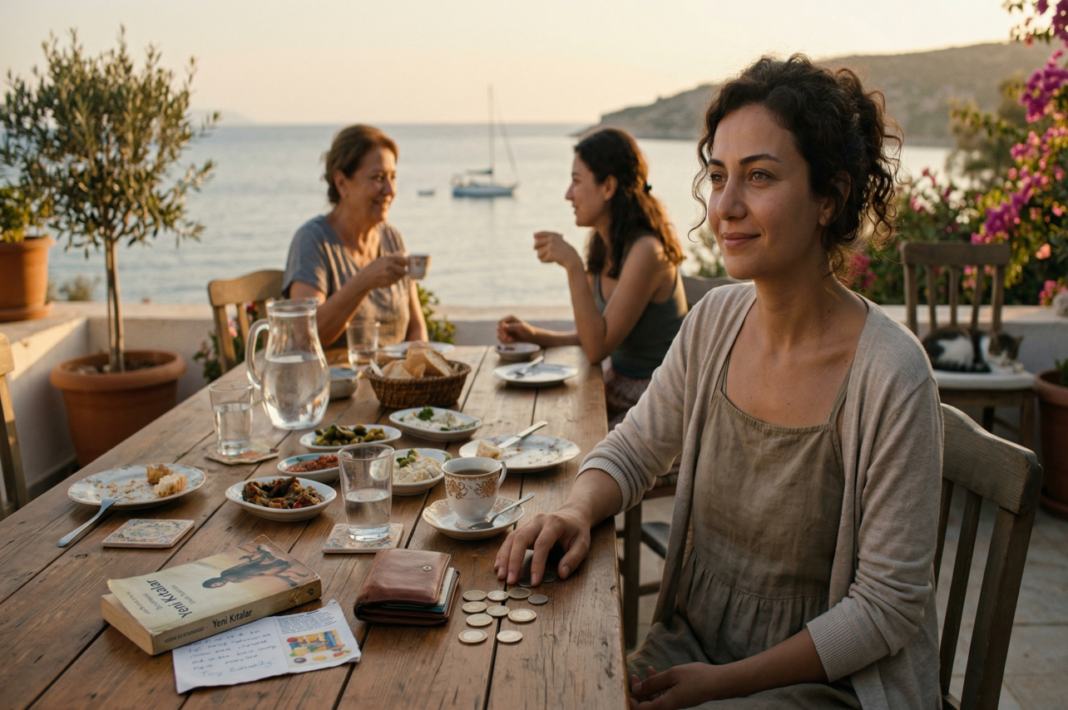
This year, we also joined the caravan of those who see the holiday as an opportunity to escape from the city. We left ourselves to the wind, colors, and long tables of the Aegean. I kissed my mother and sister plenty; I commemorated my grandmother by wearing her jacket and with a few humorous memories of ours. I didn’t keep a tally of what I ate or drank. In the evening, I counted my holiday pocket money and went to bed thinking about something I planned to buy. I felt it, I was very close to the mainland…
In the past, if you asked what “Bayram” (Holiday) meant, those advertisements of that famous beverage brand showing crowded and cheerful family tables would immediately come to my mind. Those tables where three generations gathered and caught up with each other’s lives; tables where you remembered that you were someone’s cousin, niece/nephew, aunt, uncle, or grandchild… Later, I came to the conclusion that such tables could happen in a very thin timeline: a life interval where children haven’t yet soiled their feet with the world of adults and adults are still healthy enough to chat. Yet, for some homes, these tables never existed or were emptied too early. Some tables are more modest, some are ostentatious; some tables are short, some are long; some host a “God’s guest” (unexpected visitor) at their table, some share their food with their animals… We were filling the concepts of “holiday” and “family” with the meanings we assigned to them.
Healing The Fractures Of A Divorced Family
Like many children of divorced families, I had taken my guard against these concepts over the years. I wasn’t disliking them or taking a stand; but the families I saw as a whole during holidays, my parents trying not to make us feel the lack of members in our roster, were hurting me from time to time. For my soul at those ages, my way of dealing with these situations would petrify over time without me realizing it; years later, it would be uprooted from within me along with the therapies I would receive, as if it had never happened. However, in those days, I was afraid of family warmth seeping into me and damaging the “strong” image I had adopted, or my heart being caught defenseless by the lurking bitterness. Therefore, it was quite unexpected that the institution of family would wake me up from my hibernation like a cemre (a drop of heat) that thaws the ice and softens the air in recent months.
Murathan Mungan says in his book Paranın Cinleri (1997): “If you’re not looking under a place, there’s definitely something there.” In fact, the continuation of this quote is as follows: “Because you can hide everything, but you cannot hide the fact that you hid it.” My longing for the family photo I was used to was also a truth I didn’t face. It’s interesting how people get used to everything in one way or another; to the absence of people they couldn’t replace on special days, to the times they couldn’t take refuge in their parents by escaping from a nightmare at night, to being content, to establishing new families with people they feel close to around them from time to time… Nevertheless, it wasn’t possible to fill every single one of the voids within us; there were things beyond us—so be it. Voids sometimes had to be accepted as they were—I had gotten used to this. Although having something I couldn’t control at first was hard for me, I had finally surrendered to the autonomy of empty chairs, people’s decisions, and our dynamics with those I saw as family. Truth be told, even as I write this now, my stomach tightens a bit, but I’ve gotten used to this situation too—to not fully succeeding at something, to 70% successes…
Pruning The Trees Of Nostalgia
One shaped oneself by carving and carving. Everything became lighter with suppressed emotions seeing the sun and breathing. Accepting things as they are didn’t mean forgiving everything or continuing to hold those people with the same tightness in one’s life. It meant ending a war you fought with yourself, directing your energy to deciding how the rest of your life will proceed. Instead of making the non-existent happen, struggling with “why did it happen like this,” I chose to see the Sunday breakfasts I had with my friends, the teas we drank accompanied by the songs we listened to, my sister’s constant creation of new things with her hands, the pigeon that came every day trusting that my mother would put food on the kitchen windowsill, the pleasure of the philosophical discussions I had with my father. I think nostalgia is sneaky at one point; it often misleads us into the illusion that old times were always better. But the truth is that grieving forever in the shade of my memory trees will not gain me anything. I don’t want to miss sunny days, July for being forgiven and forgiving, creating new continents. This holiday, I realized that I have probably started pruning the trees that have grown gargantuan in their shade within me. How happy!
Reference
-
Wallerstein, J. S., & Lewis, J. M. (2004). The Unexpected Legacy of Divorce: A 25 Year Landmark Study.
-
Emery, R. E. (2011). A Happy Divorce: How to Help Your Children Thrive During and After Divorce.
-
Amato, P. R. (2000). “The Consequences of Divorce for Adults and Children”. Journal of Marriage and Family.
-
Hetherington, E. M. (2003). For Better or For Worse: Divorce Reconsidered. (The effects of changes in family structure on a child’s identity development).