


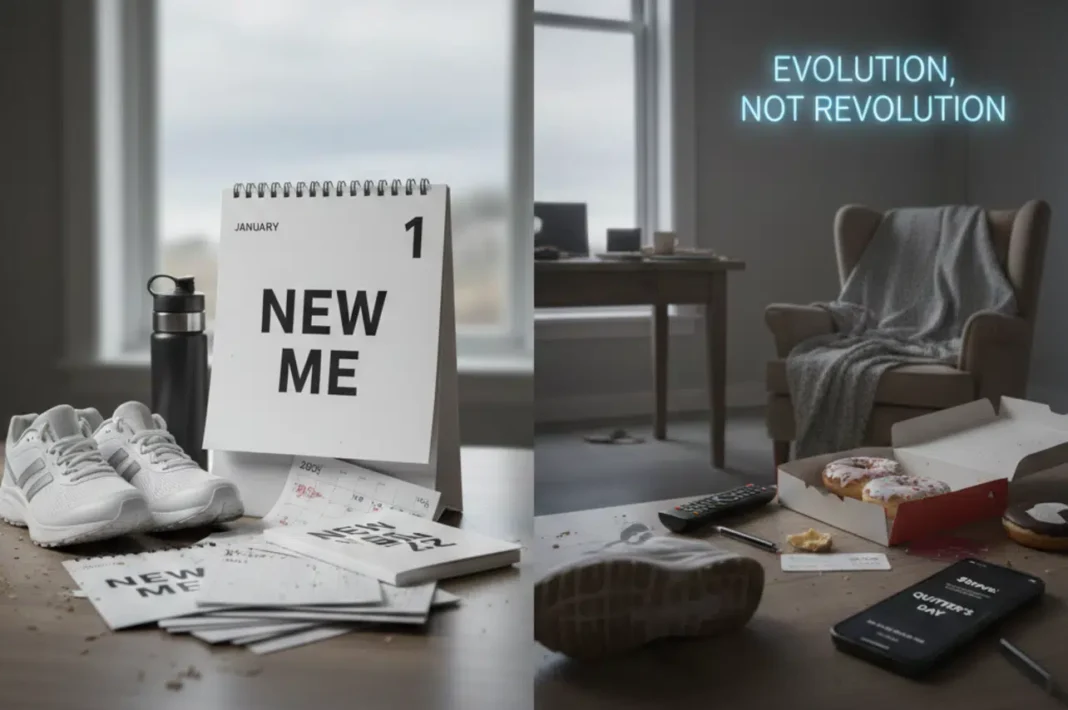

The night of December 31st serves as the glittering stage for a collective hallucination. City squares light up, our social media feeds flood with “year in review” videos, and as the hours tick toward midnight, a strange anticipation builds within us: When the clock strikes 00:00, not only will the year change, but so will we. We convince ourselves that our laziness, procrastination, bad habits, and disappointments will remain in the dusty pages of 2024, and we will wake up to the first morning of 2025 as a more disciplined, fitter, and happier version of ourselves.
Herein lies one of the greatest marketing marvels of modern times, and simultaneously one of its biggest psychological traps: New Year, New Me.
But can a changing digit on a calendar trigger a magical transformation in our neurological or psychological infrastructure? The answer is short and clear: No. In fact, this expectation is often the primary culprit behind the depressive mood many experience in February.
The Fresh Start Effect And Its Fallacy
According to the Fresh Start Effect, a theory put forth by behavioral scientist Katherine Milkman of the Wharton School, humans perceive temporal landmarks—such as birthdays, the start of a new week, or the New Year—as pivotal turning points. Our brains attempt to categorize time, erecting a mental barrier between the “imperfect past self” and the “ideal future self.” On paper, this seems like a fantastic motivational tool.
However, this mental accounting has a dark side. The desire to completely “renew” ourselves actually implies a rejection of our current selves. Aiming for radical changes based solely on willpower, without accepting who we are in the present, is akin to attempting to build a roof without first laying the foundation.
What Do The Statistics Say? The False Hope Syndrome
It is no coincidence that gyms are packed during the first week of January, only for the crowds to vanish by February. Statistics slap us with a harsh reality. A comprehensive study by the University of Scranton, published in the Journal of Clinical Psychology, reveals that only 8% of those who make New Year’s resolutions achieve their goals. Even more striking is the data from the athlete social network Strava, which analyzed over 800 million user activities to pinpoint a specific date: most people abandon their resolutions by January 19th.
In the literature, this date is now infamously known as “Quitter’s Day.”
Psychologists define this cycle as False Hope Syndrome. We set out with unrealistic expectations. The moment we stumble—say, you break your diet for one day—the “All Or Nothing” mindset kicks in. The mind says, “It’s already ruined, I failed this year too,” and throws in the towel.
Biological Reality: The 21-Day Myth
Another reason for the pressure we feel in January is our misconceptions regarding the speed of change. Popular culture tells us that a habit is formed in 21 days. However, research led by Phillippa Lally at University College London has proven that it takes an average of 66 days for a new behavior to become automatic, and for complex habits, this period can extend up to 254 days. In other words, the rewiring of neural pathways in your brain is a much slower process than the turning of calendar pages.
Evolution, Not Revolution
Do yourself a favor this year and kick the “New Year, New Me” slogan out the door. Instead, focus on the concept of a Sustainable Self. Human nature does not operate like a computer that updates its operating system overnight. Change is not an event; it is a process.
Instead of writing “I will lose 20 pounds” on your goal list, write “I will treat my body with more compassion.” Instead of radical decisions, turn toward micro-habits that you can realistically integrate into your life. Remember, the person waking up on the morning of January 1st is the same person who went to bed on December 31st. And that person, with all their flaws and experiences, is not a “project to be fixed,” but a human to be understood.
References
Dai, H., Milkman, K. L., & Riis, J. (2014). The Fresh Start Effect: Temporal Landmarks Motivate Aspirational Behavior. Management Science, 60(10), 2563–2582.
Lally, P., van Jaarsveld, C. H. M., Potts, H. W. W., & Wardle, J. (2010). How are habits formed: Modelling habit formation in the real world. European Journal of Social Psychology, 40(6), 998–1009.
Norcross, J. C., Mrykalo, M. S., & Blagys, M. D. (2002). Auld lang syne: Success predictors, change processes, and self-reported outcomes of New Year’s resolvers and nonresolvers. Journal of Clinical Psychology, 58(4), 397–405.
Polivy, J., & Herman, C. P. (2002). If at first you don’t succeed: False hope of self-change. American Psychologist, 57(9), 677–689.
Strava. (2020). Year in Sport 2019 Report.