


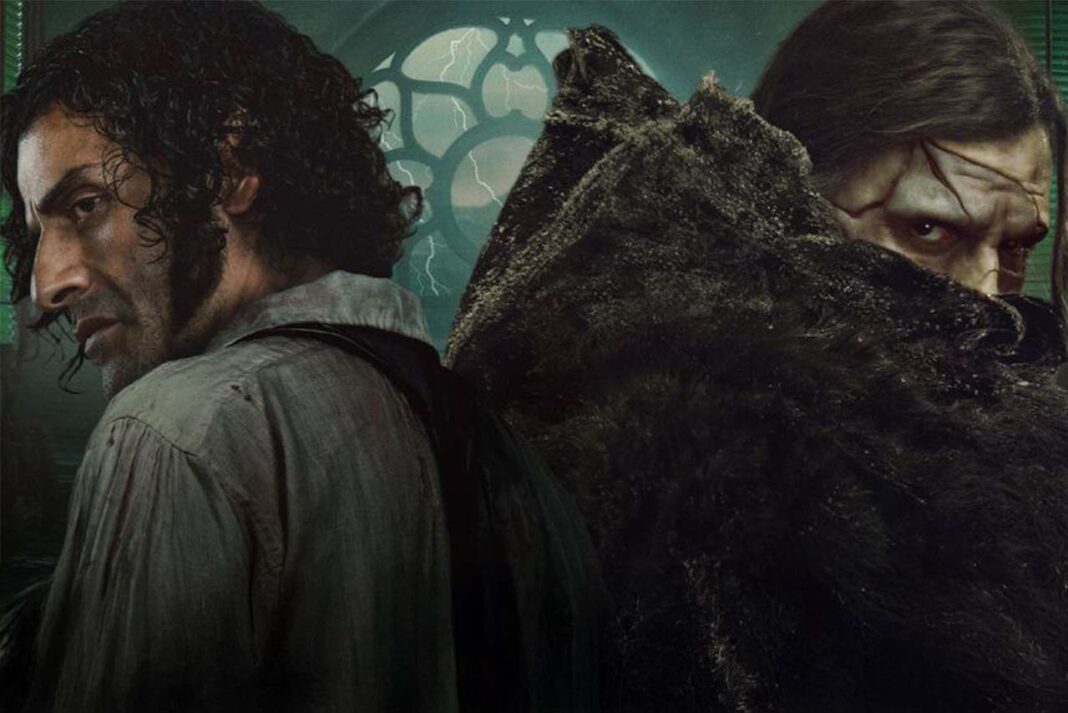

Recently the skilled director Guillermo Del Toro’s new screen adaptation of Marry Shelly’s famous book “Frankenstein or the Modern Prometheus” just entered our lives. The storyline of the movie was vastly different from the book, however it felt as if though it got one thing truly right; the heart of narrative.
Until now, Shelly’s Frankenstein has been largely taken out of context by the modern media. The story had been continually reduced into a science fiction spectacle about horror and monstrosity. However through Torro’s lens, this seems to have finally changed.
As I watched the film and read the many reviews surrounding it, I sensed a shared sentiment: Toro took a timeless classic, one that had long been reduced to a cheesy caricatured version of its own original narrative, and managed to shift the public gaze enough that he restored the heart of the story, the relationship between a negligent father and his rejected son, to the center, to its rightful place.
The Flawed Creator
As mentioned, the heart of Shelley’s story lies in the conflict between a father and his son, namely Victor Frankenstein and his creature, whom he makes and brings to life (Shelley, 1818/2003).
Victor is the creator and in effect, the father of his newborn creature. However, in raising his creature, Victor makes a catastrophic mistake.
He fails his parental duties as a creator-father and refuses to nurture or guide the creation that he intentionally gives life to, a moral failure that echoes throughout the narrative.
Some critics, Goswami (2018), for instance, even argue as such: “Mary Shelley’s Frankenstein should be read not only as a foundational work of science fiction or Gothic literature, but also as a serious meditation on the ethics of parenthood.”
From this perspective, Victor Frankenstein’s deficiencies as a creator-parent become central to understanding Shelley’s story, especially the tragic fate of her monster.
The Absent Father
According to the previous analysis, the tragedy that befalls both Victor and the creature at the end of the story is ultimately caused by Victor’s total failure to parent his creation properly (Jackson, 2018).
For example, after creation, the moment Victor beholds the looks of his creature, its appearance repels him to great extents. He repeatedly calls the creature his “filthy creation” and even labels the creature as a “wretch” (Shelley, 1818/2003).
From that on, unable to face his horrifying creation, Victor instantly renounces all responsibility towards the being and abandons the creature at the instant of its birth. He runs away as if he isn’t the one responsible for the creature’s unbearable appearance and he refuses any sense of duty for the life he has created (Jackson, 2018).
Victor does not provide guidance, companionship, or even a name for his own creation. He brings something new into this world, yet he lacks the compassion, patience, and wisdom to teach this being about the world. He severely neglects his child both physically and emotionally.
Such a model of parenting mirrors real-world patterns of parental neglect, and the novel thus becomes a critique of irresponsible parenthood (Goswami, 2016).
The Rejected Child
Critics also note that the creature’s psychological development becomes deeply harmed by Victor’s blatant neglect (Jackson, 2018).
In her book Maternal Thinking: Toward a Politics of Peace, philosopher Sara Ruddick suggests that caregivers should first preserve their children by meeting their basic needs, then nurture them by meeting their psychological and emotional needs, and finally prepare them for inclusion in the social world they live in (Ruddick, 1989).
Victor, as an absent father, fails at all three of these stages. He neither meets the creature’s basic needs nor provides psychological or emotional support. However, the third stage is where Victor truly lets his creature down (Goswami, 2018).
Victor provides his creature with a look that could be classified as “abhorrent,” which makes the creature socially unacceptable. Hence, the creature is left with literally no place in society (Goswami, 2018). And this exclusion leads to tragedy.
In fact, as his first crime, the creature murders a child, Victor’s younger brother William, who becomes terrified by his appearance (Shelley, 1818/2003).
Although the act is horrific, the creature does not kill out of an inherent instinct for violence but out of a growing desperation shaped by constant prejudice. It is a painful reality, yet also a reality Victor as a father could’ve and should’ve prepared his creature for.
Hence the responsibility for this violence lies not only with the creature but also with Victor, whose failure to create a being capable of entering society without fear or rejection directly contributes to the tragedy.
The Making of a Monster
In the end, Victor’s irresponsibility in bringing a socially unacceptable creature into this world and his absence as a father leave the creature homeless, friendless, and with the sole motive to destroy every possible cause of Victor’s happiness, which consequently destroys Victor himself (Goswami, 2018).
The story proves the saying “violence breeds violence,” and Frankenstein shows us how abusers end up creating other abusers.
The creature commits acts of violence not because he is inherently cruel, but because, lacking proper guidance, violence becomes the only solution he can see.
Which makes Shelley’s novel more than just a monster-tale, but rather a philosophical exploration into the concepts of creation, responsibility, and most importantly, parenthood.
So in the end, the novel becomes a warning to all parents, for if one day, they ever fail to nurture a life entrusted to them, they can always read Frankenstein, and remember the consequences.
References
Goswami, D. (2018). ‘Filthy creation’: The problem of parenting in Mary Shelley’s Frankenstein. Rupkatha Journal on Interdisciplinary Studies in Humanities, 10(2).
Jackson, H. (2018). Creating a monster: Attachment theory and Mary Shelley’s Frankenstein. The Oswald Review: An International Journal of Undergraduate Research and Criticism in the Discipline of English, 20, Article 7.
Ruddick, S. (1989). Maternal thinking: Toward a politics of peace. Beacon Press.
Shelley, M. (2003). Frankenstein; or, The modern Prometheus. Penguin Classics. (Original work published 1818)