


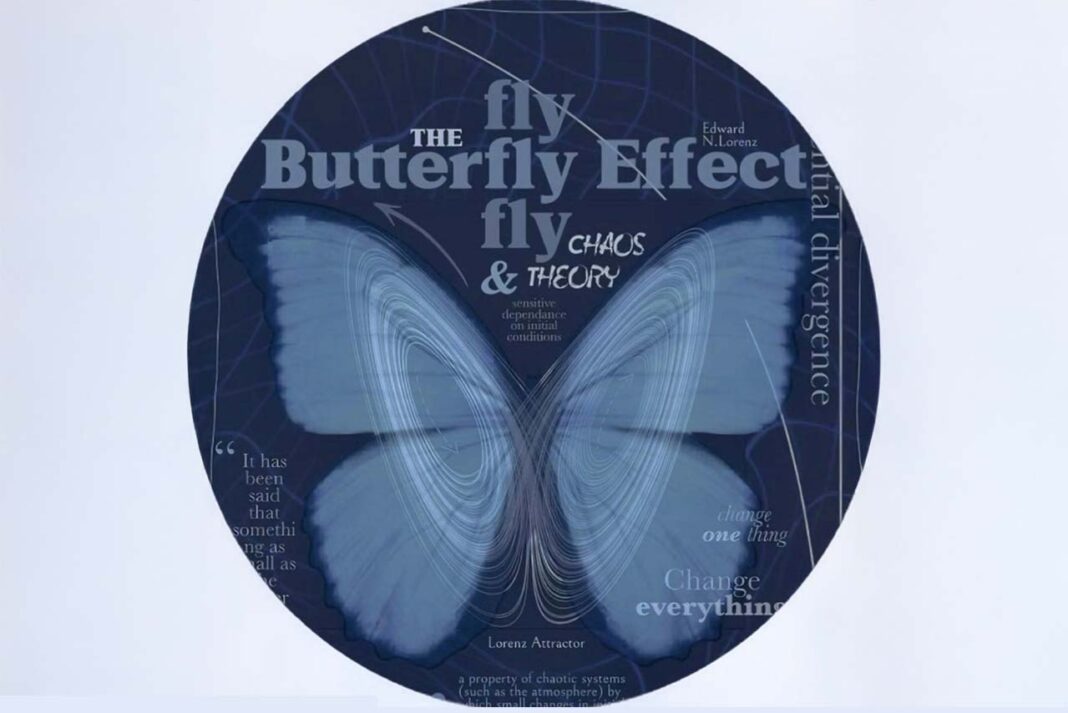

In the literature, the butterfly effect refers to the idea that a small change in a system can lead to major differences in the final outcome. As the popular example suggests, a tiny air current created by a butterfly flapping its wings in the Amazon Rainforest may trigger a chain of events that eventually turns into a massive storm on the other side of the world.
We all exist within a flow between the past and the future. The past cannot be changed, and the future cannot be reached ahead of time; this continuity represents the uncertainty and unpredictability of fate.
The butterfly effect shows how even the smallest details of our past shape our present and how the unchangeability of the past gives meaning to the variability of the future. Within this complexity, we begin to understand how the delicate flutter of a butterfly’s wings may turn into a disaster somewhere else.
In psychology, the butterfly effect is understood as the “macro impact of micro experiences.” A single word spoken years ago by someone you once met may still leave a trace on you. Trauma works the same way: a small moment can transform into a deeply tangled impact years later.
Many of the things we encounter in life are part of the same chain. For instance, you may miss your bus because of an unlucky moment in the morning; on the next bus, you might meet someone—familiar or a complete stranger—who shifts your life’s direction. That person might bring you an opportunity, or they might make your life more complicated. This suggests that every positive or negative possibility carries a certain sense of fate.
In Ahmet Ümit’s line, “My walls were completely bare. I never hung the frames for years, thinking they would look bad,” the sense of delay and the fear of possibilities mirror this theme. Yet a single glance, a brief heartbeat, a barely noticed moment while turning your head can create enormous change. This is the mathematics of living small moments with awareness.
Even if the past casts its shadow onto the future, and even if the future stands before us with all its uncertainty, all theories converge on one essential point: the present moment. Because the greatest potential of the past is always hidden in the now.
Chaos Theory | Realizing That Life Comes From You, Not to You
The fundamental principle of chaos theory—the butterfly effect—explains that in a deterministic yet nonlinear system, a tiny difference in initial conditions can lead to drastically different outcomes. What looks like “disorder” actually contains a powerful underlying order.
Even when nothing in our lives goes according to plan, perhaps that is the plan itself. The universe operates through mathematical laws and an unseen structure. Human perception is chaotic; the system itself is never truly random.
This perspective reshapes how we think about fate. It suggests that fate comes from life, that life flows from us rather than toward us. As Albert Einstein’s phrase “God does not play dice” implies, every event unfolds with a certain causality.
When you look at your life through a wider frame, you notice that small fractures have carried you to where you stand today. The way events occur can change, possibilities can shift—but the essence of the outcome often remains intact. The length of the journey or the difficulty of the path only changes the taste of the experience. Drinking water is drinking water in every version; for fate, the form of an action changes, but its essence does not.
A Perfect Day for Evan
The film The Butterfly Effect, centered on the concept of fate, significantly contributes to the fascination with these theories. Evan Treborn, who experiences memory lapses and traumatic events in his childhood, discovers that he can return to the past and alter events. However, each correction leads to a new rupture. This process strongly highlights time paradoxes and the unchangeability of fate.
Though Evan seems able to improve the lives of others, he eventually realizes that he has no true life path of his own and that everything collapses into the same outcomes. As the viewer watches Evan alter his past repeatedly, the way the core result remains unchanged encourages deep reflection. Yet the question “If I could change the past, would my present be different?” naturally awakens a sense of hope.
The past always stands before us in all its boldness. Even if the future awaits us with all its brilliance, the shades of the past seep into its undertones; no matter what color you paint over it, the mixture will always reveal its origin. In our lives, absence occupies more space than excess; perhaps that is why we dwell so much on the past.
Even when Evan changes both the past and the future countless times, the essential outcomes of the people he touches do not change. Because no matter the version, fate remains the most dominant character in the story.
And finally, the question turns to the viewer:
If you were in Evan’s place, which moment would you travel back to?
If you could watch your own life as an observer, knowing that the person you are today is the sum of every small and large moment, what path would you choose?
References
• Lorenz, E. N. (1963). Deterministic Nonperiodic Flow. Journal of the Atmospheric Sciences, 20(2), 130–141.
• Gleick, J. (1987). Chaos: Making a New Science. New York: Viking.
• Einstein, A. (1926). Correspondence with Niels Bohr.
• Ahmet Ümit. (2001). Beyoğlu Rapsodisi.