



From the perspective of psychological development, taking responsibility is generally regarded as a positive thing and most of the time, it truly is. Having a sense of agency over one’s own life, being able to see the consequences of one’s choices, contributing in meaningful ways, and assuming obligations when necessary are all important parts of psychological maturation.
Responsibility does not merely assign tasks; it also gives a person a sense of being an active subject in life. The feeling of “I can do this,” “I can contribute,” “I am someone who has an impact on my own life” is one of the quiet foundations of psychological resilience.
There is, however, an important distinction to be made here: not every burden assumed is truly responsibility, and not every act of carrying is a sign of maturity. There is a clear difference between taking on healthy psychological responsibility and carrying burdens that do not belong to you. In the emotional realm especially, this boundary becomes even more critical. Many people grow up confusing being responsible with being obligated to regulate other people’s emotions and they begin making that confusion very early in life.
Carrying Another Person’s Emotions
One of the patterns we frequently encounter in adult psychology is this: a person feels responsible for the emotional comfort of those around them.
This is, in fact, one of the most common patterns we see in adult psychology today. A person comes to feel responsible for the well-being of others.
-
They suppress their own feelings so that no one else will be hurt.
-
They remain silent so the atmosphere will not be disturbed.
-
They speak carefully so that someone’s anger will not escalate.
They postpone their own inner burden so that the people close to them will not fall apart. At first glance, this may look like empathy, understanding, or self-sacrifice. Yet beyond a certain point, it ceases to be healthy responsibility and becomes a way of adding someone else’s emotional burden to one’s own inner world.
This is precisely where psychological boundaries become essential. Every individual is, first and foremost, responsible for their own emotions, their own reactions, and their own capacity to regulate their life. Of course, in relationships we affect one another, support one another, soothe one another, carry each other at times, and sometimes help shoulder each other’s burdens. But when a person continuously takes responsibility for another’s emotional balance, makes it their task to keep someone calm, or begins carrying another person’s fragility in their own body, their own psychological space begins to narrow.
-
They stop asking what they feel and start thinking about what the other person might feel.
-
They stop asking what they want and start calculating what the situation can tolerate.
In this way, the sense of responsibility can quietly turn into self-erasure.
Maturity Does Not Mean Taking On Everything
For this reason, psychological maturity is not only about taking responsibility; it is also about recognizing the limits of responsibility. Taking on everything is not maturity. Managing everyone is not a sign of strength. Understanding another person’s pain is valuable, but taking their emotional fate onto your own shoulders is not healthy.
Very often, this points to something else: that the person has learned to minimize their own needs. The issue is not always being too sensitive; sometimes it is that sensitivity has turned into a form of overburdening that knows no boundaries.
And this is exactly where the issue reaches children. Because this confusion often does not begin in adulthood; it is learned in childhood. Some children begin to sense, at a very early age, that:
-
Peace at home is fragile.
-
If my mother is sad, I must be careful.
-
If my father is angry, I must stay quiet.
-
I must not tire anyone any further.
-
I must not cause problems.
-
Even if I am upset, I must not show it.
A child who begins reading the emotional climate of the adults around them at such a young age gradually develops a role that does not belong to their age. They become, in effect, the invisible regulator of the household. These children are often described as well-behaved, calm, mature, and understanding. But when we look more closely, this is not always healthy maturity.
Children who are forced to behave like adults often go unnoticed. Because the child who does not draw attention is, after all, the child the system can tolerate more easily.
The child who does not cry, does not ask for much, takes up little space, and recovers too quickly is often assumed to be “fine.”
But sometimes the opposite is true. The child is not quiet because they are truly well; they are quiet because they learned far too early not to be a burden. They make themselves small because they sense that expressing vulnerability is not safe. They turn postponing their own needs into a skill. And for that very reason, some children who appear strong from the outside may, inwardly, have become heavy far too soon.
The Narrowing Of Childhood
Even what has been described so far is, in itself, an important psychological issue. Yet in some parts of the world, the narrowing of childhood is not experienced only on an emotional level. Some children are forced to carry not only the sorrow of others, but also the most concrete burdens of life itself.
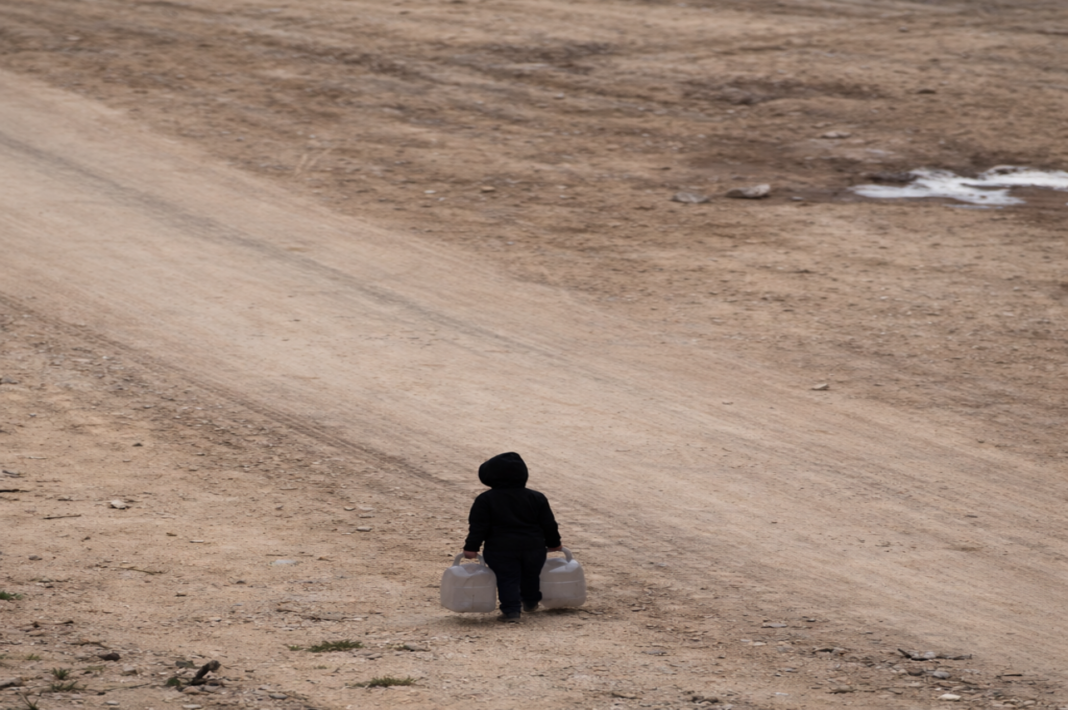
We see this clearly in places shaped by war: children are handed not toys, but things they must carry; their days are spent not in curiosity, but waiting in lines for necessities; their shoulders grow heavy before their bodies have even grown.
A small child walking barefoot, trying to carry a large container of water nearly as tall as themselves over a long distance… The issue here is not only thirst or deprivation. The deeper issue is the taking away of childhood itself.
Childhood is not a period lived without ever knowing the weight of life; but it is a period in which one should not be forced to be shaped under that weight.
Not Responsibility, But Necessity
Of course, a child can carry water; they can help, eagerly join in a task, and want to feel useful. But what we see here is not developmentally supportive responsibility. It is the weight of survival. It is not a burden the child chooses to contribute to, but one imposed by circumstances. From a psychological point of view, that distinction is decisive.
Children living in war are often defined not only by fear, but also by premature functionality.
-
They ask for less.
-
They adapt more quickly.
Rather than expressing what they need, they try to understand what is missing. Even though they are of an age when they should be playing, they begin to notice what is required for daily life to continue: water, bread, silence, hiding, waiting, carrying.
Under normal circumstances, a child’s relationship with responsibility develops within the natural rhythm of growing up. They take on small tasks, and then return to play. They carry something, but can put it down when they get tired. They help with something, but know that the real burden is being carried by an adult. They come to know the world not as a place collapsing onto their shoulders with its full weight, but as a space in which they can:
-
make mistakes,
-
receive support,
-
and withdraw when they need to.
This is, in part, what healthy development means: a child becomes familiar with responsibility, but is not forced to be shaped underneath it.
For a child living amid war and severe devastation, however, the same process unfolds very differently. There, responsibility is not a slowly learned skill; it is an early imposed necessity. A child carries something not simply to contribute, but to make up for what is missing. They cannot put it down when they are tired, because putting it down may mean giving up on a need. The distinction between helping and being obliged disappears.
Responsibility and Psychology
An ordinary child gradually becomes stronger through responsibility. A child in war, by contrast, often does not become stronger they become hardened. In one case, self-efficacy develops; in the other, a state of compulsory hypervigilance. In one case, the child grows with the feeling of “I can do this”; in the other, they grow heavy with the feeling of “I have to do this.”
As a society, we sometimes slip into a troubling kind of romanticization here as well. We describe children who have been made heavy too soon as “so strong,” “so resilient,” “so wise beyond their years.” Yet such expressions often render invisible the excess they were forced to carry. Resilience is certainly valuable but the fact that a child has to be this resilient is not a cause for praise. It is cause for alarm.
Because childhood develops healthily only to the extent that a person is first able to experience the world as a safe place.
Psychology tells us this: a person is shaped not only by what they live through, but also by the roles they are forced to assume.
The child who is always expected to manage everything may grow into an adult who takes excessive responsibility in relationships.
-
The child who is always expected to stay calm may grow ashamed of their own anger.
-
The child who carries everyone else’s emotions may one day struggle to recognize their own.
-
And children who are forced to carry real burdens far too early struggle not only physically, but also in building a fundamental sense of trust in the world. Because what settles inside a person during childhood is not only memory; it is a basic belief about what kind of place the world is.
This is why we must use more careful language when speaking about responsibility. Taking responsibility is valuable; but carrying weights that do not belong to you is not a virtue. Filling yourself with the emotional burdens of others is not healthy maturity. When children become quiet too soon, capable too soon, resilient too soon, that is not always something to admire. Sometimes each of these is a sign that childhood has quietly withdrawn.
The essential question still remains the same: if a child’s task is not to carry burdens, but to grow, when did we begin treating prematurely burdened children as normal?
And perhaps this is the most painful part of all: that someone who is still a child is forced to grow up inside a weight that does not belong to their age.