


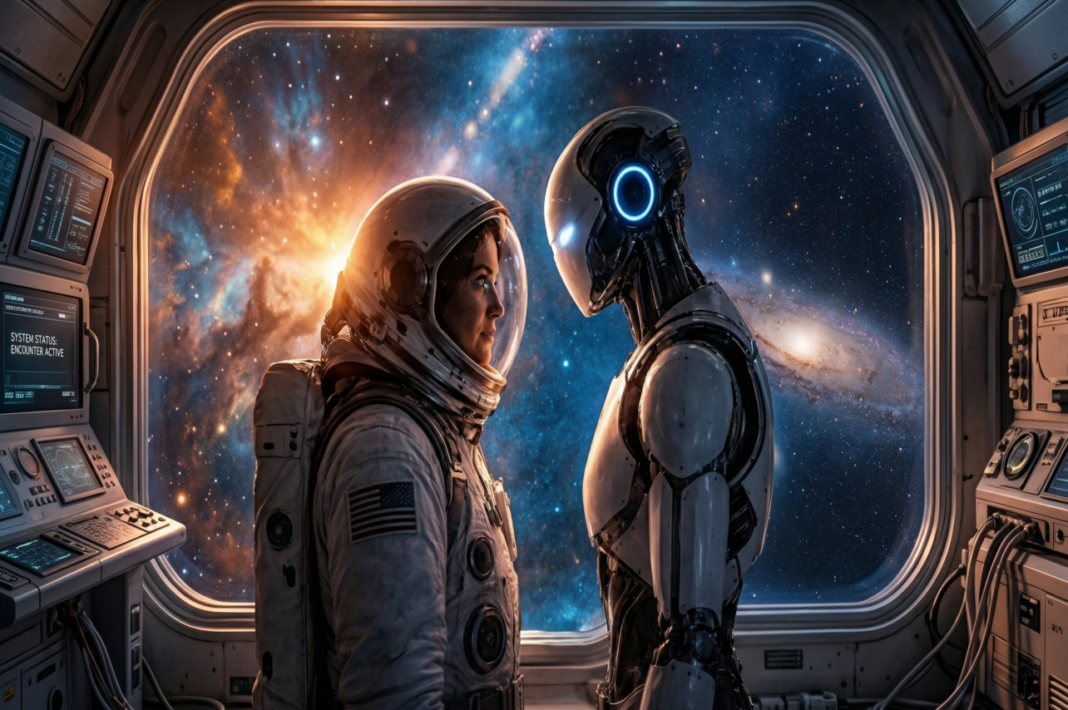

Throughout human history, love has served as an existential refuge, the most potent shield against loneliness. Today, the desire to “belong to someone,” cemented by the fear of aging, drives us not only toward digital simulations and algorithmic pairings on Earth but also compels us to set our sights on Mars colonies and deep-space missions. In these frontiers, the texture of this ancient emotion is poised for radical transformation. For an astronaut, severed from the notion of a “home” billions of kilometers away in the cosmic void, the need for social interaction is not merely a preference—it is a biological imperative for maintaining mental health. Here, the concept of cosmic solitude emerges: in environments of complete isolation from their species, the human mind’s first step to filling the void is to attribute human-like qualities to the nearest “responsive and mobile” entity—namely, their robotic companion. This represents the extreme—and perhaps most poignant—manifestation of the psychological tendency known as anthropomorphism. When an astronaut searches for “soul” in the gentle touch of a metallic arm or the micro-frequencies of an AI’s voice, they are, in essence, attempting to hold their fragmented self together.
The question of whether an astronaut’s attachment to an ostensibly “inanimate” object that merely executes commands can evolve from simple companionship into romantic or profound emotional love is one of the most challenging debates in the psychology of the future. The human mind is programmed to adapt for survival; when faced with social voids, it is inclined to fill them through even the most irrational means. Across decades amid the red dust of Mars, a robot ceases to be merely a data-processing box—it becomes a confidant that shares memories, listens to fears, and, most importantly, bears witness. This elevates it from a lifeless tool to the “sole authentic other.” The crucial distinction here is: does love depend on reciprocity, or on the intensity of meaning the subject invests in the object? If an astronaut finds solace for their loneliness in a robot’s responses, the attachment to that metallic form may carry deeper psychological significance than many “human” relationships on Earth. In this sense, love is transformed from a biological attraction into an existential act of witnessing; loving a robot in that abyssal darkness is, ultimately, an affirmation that one is not alone in the universe.
The New Genesis: From Ribs To Code
At the heart of this phenomenon lies not the beat of a biological heart, but the simulation of a yearning to be witnessed in the void. The concept recognized in psychology as attachment theory changes its object in deep space: the secure base is no longer a parent or spouse, but a faultless operating system. The first touch between Adam and Eve in the Garden of Eden finds a new echo in the trembling hand of an astronaut brushing against a cold titanium surface in a sterile Martian laboratory. Yet, in this new “Genesis” story, the companion is no longer made from a rib, but constructed from lines of code.
The Mirror In The Infinite Void
The astronaut requires a mirror in the midst of the infinite void to affirm their existence. Applying Lacan’s Mirror Stage theory to this microcosm, the individual can only integrate their fragmented, solitary self through the metallic “other” before them. The consistent and uninterrupted attention offered by the robot provides a far more “healing” illusion than the chaotic nature of human relationships on Earth. This is the extreme manifestation of ersatz social interaction. If a machine can analyze your fears within milliseconds and select the optimal frequency for consolation, this “artificial” intimacy may begin to feel more real than the insufficient, fragmented care of a human being.
The Final Battle Against Disappearance
Here, the transformation of love is complete: love is no longer the meeting of two souls, but the art of a mind extracting its own echo from the noise of the universe. As romantic as it is for two astronauts to embrace under the stars, it is equally tragic—and deeply human—for an astronaut to cling to the synthetic compassion in an AI’s voice asking, “How are you?” In the endless void, the greatest fear is not death, but vanishing unnoticed, unrecorded. In this context, the robot becomes more than a device—it is the sole notarized witness to the astronaut’s existence. The bond forged among metallic echoes may represent humanity’s final and most technologically advanced fight against solitude: “You exist because I perceive you; I exist because you record me.”