


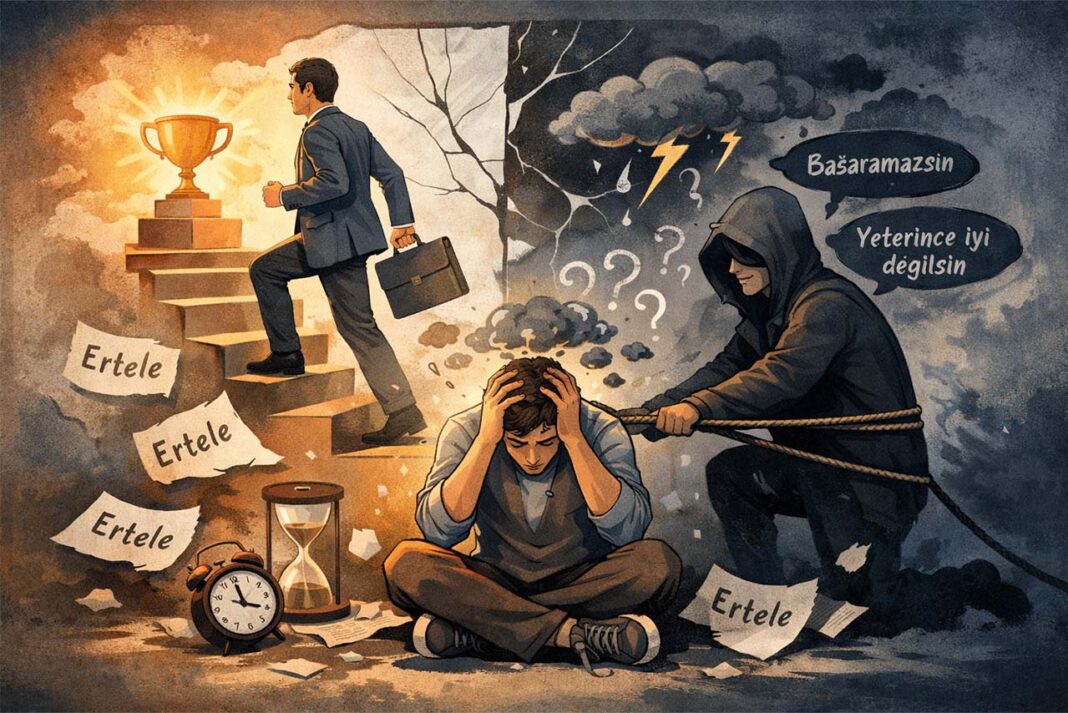

While studying psychology, one thing I started to notice more clearly is this: people often struggle not because they fail, but because they stop themselves just when they could succeed. Before an important exam, they postpone studying. When a good opportunity appears, they say, “I’m not ready yet.” Sometimes, even when a relationship is going well, they suddenly create distance for no obvious reason. Honestly, I have noticed some of these patterns in myself as well.
In psychology, this pattern is referred to as self-sabotage. Self-sabotage describes behaviors—conscious or unconscious—that make it harder for a person to succeed, perform well, or maintain psychological well-being. What is interesting is that these behaviors are usually not about harming oneself. In many cases, they function as a way of protecting oneself from emotional discomfort.
How Does Self-Sabotage Appear In Daily Life?
When we hear the term self-sabotage, we often imagine extreme behaviors. In reality, it usually shows up in very ordinary ways. Chronic procrastination, leaving tasks until the last minute, starting something without proper preparation, or giving up with thoughts like “it won’t work anyway” are common examples.
Looking around, I have noticed that some people make more mistakes when they are close to success, while others withdraw just as things begin to move forward.
Research supports this observation. Self-sabotage is often driven not by fear of failure itself, but by the desire to avoid the emotional consequences associated with possible failure (Zuckerman & Tsai, 2005).
Failure is familiar. People know how it feels and how to cope with it. Success, on the other hand, brings uncertainty. And uncertainty can be especially uncomfortable for individuals who experience high levels of anxiety.
Fear Of Success: Why Does Moving Forward Feel Difficult?
We often talk about fear of failure, but modern psychological research suggests that some individuals are actually afraid of success. Success often comes with increased responsibility, higher expectations, and greater visibility. This can create intense pressure.
For people who tie their self-worth closely to achievement, success can stop feeling rewarding and instead become something that must be constantly maintained. As a result, some individuals unconsciously pull back. If they fail, they can explain it by saying, “I didn’t really try.” While this explanation may seem simple, it serves an important function in protecting self-esteem (Martin, Marsh, & Debus, 2003).
Inner Conflict: The Part That Wants To Grow And The Part That Is Afraid
At the core of self-sabotage, there is often an inner conflict. One part of us wants to grow, change, and move forward, while another part wants to stay in a familiar and safe space. When these two parts clash, instead of making a clear decision, people sometimes sabotage the process itself.
Psychological research explains this through self-regulation processes. When individuals are emotionally drained or under prolonged stress, their ability to regulate themselves decreases, making avoidance behaviors more likely (Baumeister & Vohs, 2007). In this sense, self-sabotage is not always a conscious choice, but sometimes a result of emotional exhaustion.
This perspective feels very human. Everyone experiences moments when making decisions feels overwhelming.
The Link Between Procrastination And Self-Sabotage
Procrastination is one of the most common forms of self-sabotage. Many people think procrastination is simply a time-management problem. However, modern approaches emphasize that procrastination is largely an emotion-regulation strategy (Sirois & Pychyl, 2013).
When a task triggers feelings of anxiety, self-doubt, or fear of making mistakes, delaying the task provides short-term emotional relief. Unfortunately, in the long run, procrastination increases stress, strengthens feelings of guilt, and damages self-confidence (Sirois, 2014). Over time, this cycle reinforces self-sabotaging patterns.
Can Self-Sabotage Be Changed?
Self-sabotage is not a fixed personality trait. It is a learned coping strategy, which means it can be changed once it becomes visible. One of the most important steps is asking a simple but powerful question:
“What is this behavior protecting me from?”
This question shifts the focus from self-blame to understanding. Dealing with self-sabotage requires developing a more honest and compassionate relationship with oneself.
Conclusion
People self-sabotage because the mind often prioritizes emotional safety over growth. While self-sabotage may feel protective in the short term, it limits personal potential in the long run. Becoming aware of these patterns is an important step toward change. Sometimes, the most meaningful progress begins when we stop standing in our own way.
References
Baumeister, R. F., & Vohs, K. D. (2007). Self-regulation, ego depletion, and motivation. Social And Personality Psychology Compass, 1(1), 115–128.
Martin, A. J., Marsh, H. W., & Debus, R. L. (2003). Self-handicapping and defensive pessimism. Journal Of Educational Psychology, 95(1), 37–49.
Schwinger, M., Wirthwein, L., Lemmer, G., & Steinmayr, R. (2021). Academic self-handicapping and achievement. Contemporary Educational Psychology, 65.
Sirois, F. M. (2014). Procrastination and stress. Personality And Individual Differences, 61–62, 28–33.
Sirois, F. M., & Pychyl, T. A. (2013). Procrastination and emotion regulation. European Journal Of Personality, 27(2), 197–204.
Zuckerman, M., & Tsai, F. F. (2005). Costs of self-handicapping. Journal Of Personality, 73(2), 411–442.