


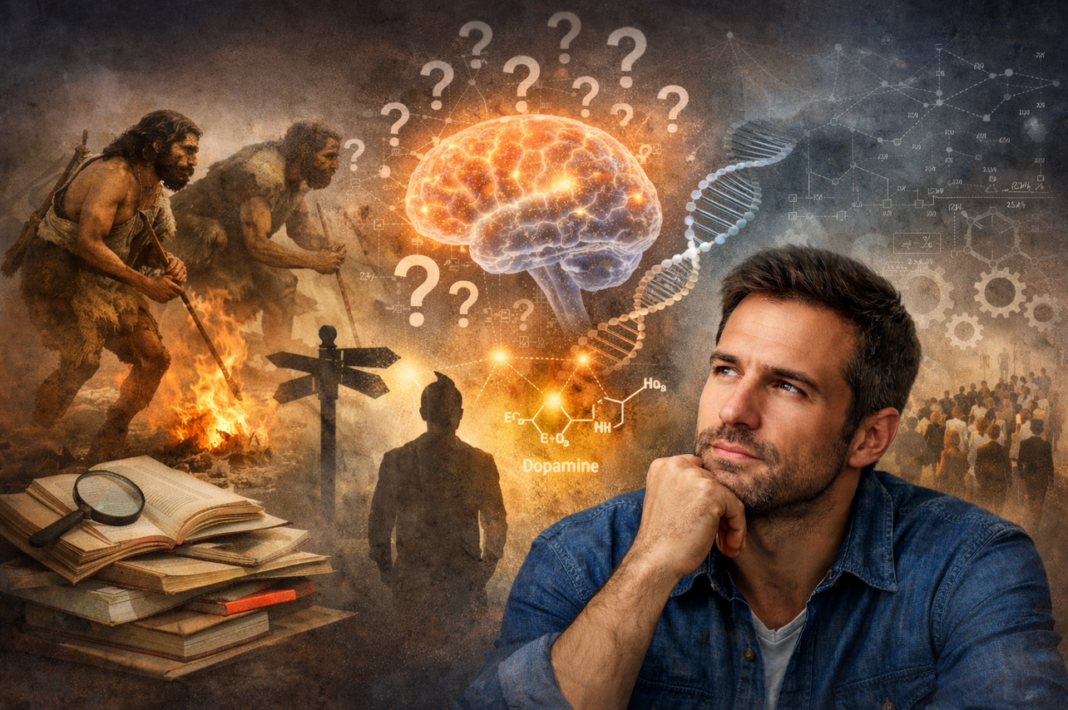

Why do we constantly ask “why?” In fact, even now there is an effort to learn a reason. So, is this really the question humans ask the most? In this article, let me explain the biological, psychological, and social foundations of our effort to learn the reasons behind things.
Survival Instinct (Evolutionary Reason)
The human quest for “why?” is actually part of the survival mechanism. According to Evolutionary Psychology, organisms have learned to predict dangers in advance by figuring out the causal structure of events around them. Since the dawn of life, we’ve learned that uncertainty and the unknown are potential threats. To this day, humans have also learned that establishing cause-and-effect relationships is a way to manage threats.
In early human communities, not knowing the cause of an environmental event (such as a sound) reduced the chances of survival. In the survival equation, the unknown outweighed the known, and humans began to search for causes in order to continue living. Therefore, the brain developed the ability to produce causal explanations as a powerful adaptation.
Today, even though the known outweighs the unknown and individuals are not in danger, the question “why?” is still fueled by the same evolutionary mechanism: being alert to the uncertain, anticipating the potential consequences of an event, and managing or avoiding danger. Therefore, the human mind tends to automatically assign a cause to every event.
Our Brain’s Love Of Order (Cognitive Reason)
The human brain is an organ that seeks order, structure, and meaning. Our brain perceives chaos as disorder and meaning as comfort. Therefore, knowing the cause of an event organizes memory, categorizes events, and enables us to plan future behavior. This mechanism, called “pattern recognition,” is the brain’s way of using its limited energy efficiently.
Seeing the world as orderly reduces cognitive load; finding order allows us to predict the future, and being able to predict forms the basis of our sense of security.
According to Cognitive Psychology, the human mind values causal connections for three reasons:
-
Learning: People who know the cause change their behavior based on that knowledge.
-
Memory organization: Cause-and-effect relationships enable information to be represented more strongly in memory.
-
Predicting the future: Knowing the cause makes it possible for us to anticipate a similar situation in the future.
For this reason, rather than passively accepting raw information, the human mind actively constructs cause-and-effect sentences.
Need For Control (Psychological Reason)
In psychology, we explain our need for control with the concept of “locus of control.” As people learn the reasons behind events, they feel more predictable, powerful, and prepared. Not knowing the reason behind an event creates a feeling of “coincidence,” which can be uncomfortable for most people.
We humans are a species that tries to control uncertainty. That’s why learning the reason increases our self-confidence, reduces our anxiety, and makes the possibility of it happening again controllable.
We can see a more intense search for reasons in people with a weak sense of control. This is because the desire to find a reason is itself a psychological regulation mechanism.
Anxiety And Sensitivity To Uncertainty
It is important to note that each person has a different “tolerance level for uncertainty.” This concept is referred to as Intolerance of Uncertainty (IU) in clinical psychology. In individuals with high IU levels:
-
The event being unexplained
-
The absence of clear information
-
The possibility of “What if…?” scenarios
can cause high anxiety.
For these individuals, finding out the reason is a means of emotional regulation. Knowing the reason:
-
Calms the brain’s threat system
-
Increases the control of the prefrontal cortex
-
Reduces the excessive activation of the amygdala
Therefore, asking why is sometimes not just a search for information, but also a behavior to regulate anxiety.
Identity And Worldview Construction
People sometimes make attributions to events. We ask many questions such as:
-
“Why did this happen?”
-
“What was the reason someone treated me this way?”
-
“What can I attribute this failure to?”
According to Fritz Heider’s Attribution Theory, people focus on three things when looking for reasons:
-
Internal causes: The person’s characteristics
-
External causes: Environmental conditions
-
Chance / coincidence
This process is used in every area, from relationships to social analysis. For example:
-
When someone behaves rudely: “They are rude as a person” (internal attribution)
-
“They may be tired” (situational attribution)
This completely changes the emotional response.
In other words, the search for reasons is a cognitive tool that people use to make sense of their social relationships and position themselves in the world.
Curiosity And The Dopamine System
Satisfying curiosity is actually a need for us humans. When we learn a new reason, our brain releases dopamine. Therefore, learning why creates a truly rewarding experience in the brain.
That’s why finding the reason gives pleasure. We enter a cycle of learning information → dopamine → curiosity again. This continuous Dopamine System loop pushes the individual to ask “why?”
Social And Cultural Learning
So far, we have discussed the biological and psychological foundations of the desire to learn why. Yes, humans are naturally curious; however, the form of the search for why is culturally shaped.
Families teach children cause-and-effect relationships. The school system reinforces questioning. Language organizes thoughts, and society values explanation. Therefore, the quest to learn why is not only a biological urge but also a learned cognitive behavior.
Cross-cultural research shows that in societies where questioning is encouraged, the search for why is more analytical, while in traditional structures, it is more intuitive and holistic. But in both cases, humans continue to pursue meaning as a fundamental need.
Conclusion
Considering all the reasons I have described, humans’ constant search for reasons is:
-
A remnant of the evolutionary survival mechanism
-
A fundamental function of the cognitive process
-
A behavior that regulates anxiety
-
A need to make sense of social relationships
-
A natural result of the neurobiological reward system
-
A culturally taught skill
This multi-layered structure makes the search for reasons an integral part of being human.