


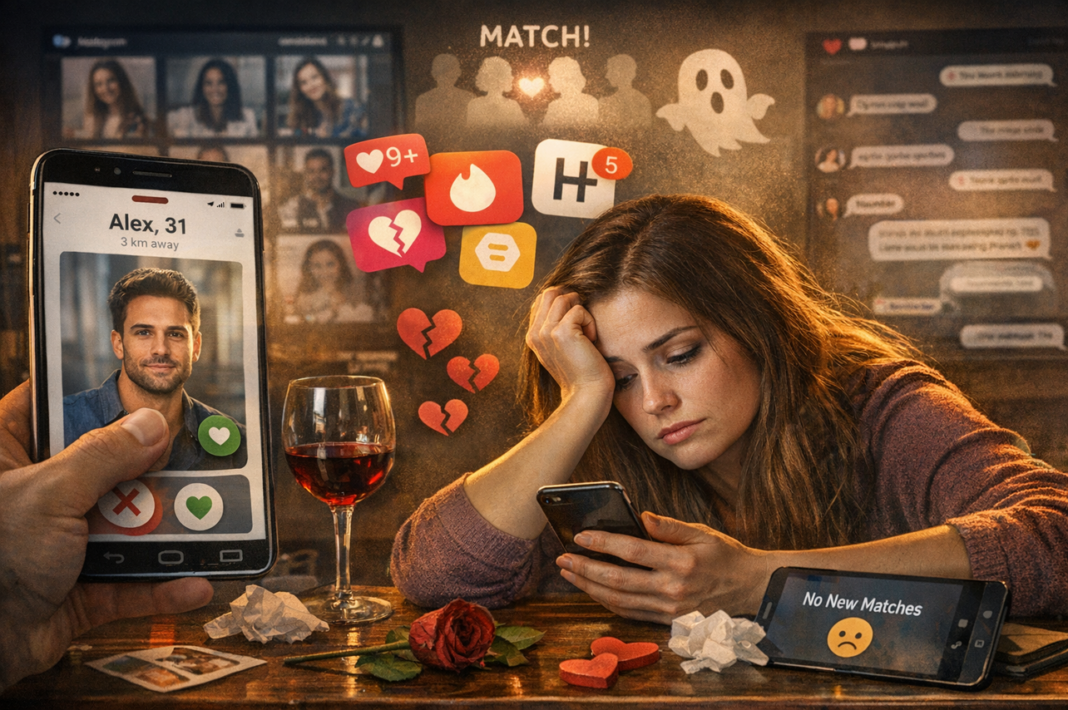

In this digital age, romantic relationships, like everything else around us, are rapidly changing. Widely used online dating platforms like Tinder, Bumble, and Hinge have made partner selection quick, accessible, and effortless. While these platforms — offering endless options at first glance — may seem like a good option, research shows that online dating is radically changing our perspective on relationships, the way we build them, and our emotional investment. With this transformation, a new era marked by increasing digital relationship fatigue and emotional instability, where we find ourselves lost among endless options, is beginning to emerge.
The Digital Relationship Market
Online dating apps are increasingly resembling a digital relationship marketplace. Self-presentation is now more important than natural interactions, personality traits, or behavior. In other words, just like a digital product, people choose their best photos, write eye-catching captions, and strive to stand out in the app’s algorithm (Finkel et al., 2020). Furthermore, an invisible hierarchy emerges within this algorithm, where some users become more visible while others remain barely noticed. This fast-paced consumption behavior, the habit of comparing profiles as if comparing products, and the resulting invisible hierarchy give rise to the concept of the Tinder economy (Bruch & Newman, 2022). Relationships shaped by this economy become less about seeking meaningful connection and more about superficial interactions within an overwhelming pool of choices.
The Paradox Of Choice
The abundance of potential partners offered by dating platforms creates the perception that we can always find someone better. While this may seem convenient at first, research shows that having too many options actually makes choosing more difficult; relationship fatigue increases, and emotional investment and satisfaction decrease (Mogilski & Welling, 2023). As users swipe left and right, it becomes increasingly difficult to determine what — and whom — to invest in. This illusion of freedom gradually turns into confusion and ultimately a vicious cycle.
Romantic Burnout
Constant scrolling, comparing dozens of profiles, and repeatedly starting and ending conversations create a new kind of fatigue: digital decision fatigue. In this state, users’ attention spans shorten, patience declines, and their motivation to form emotional bonds weakens. Research shows that the mental strain of constant decision-making among unlimited options leads to burnout, resulting in more impulsive choices and lower commitment levels (Iyengar & Lepper, 2000; Robbins, 2023).
Additionally, repeated rejection, unanswered messages, ghosting, and potential partners suddenly disappearing can lead to long-term emotional exhaustion. Online environments make it easier for people to engage in behaviors they would avoid in real life, largely because they feel less responsibility toward others. As these experiences accumulate, motivation for relationships decreases, and the effort and emotional investment people put into connections steadily diminish (D’Angelo & Toma, 2021).
The Loneliness Cycle
Attachment styles in modern dating apps also influence how people form and maintain relationships. Research shows that avoidantly attached individuals feel more comfortable on dating platforms because low-investment, loosely defined relationships are easier to establish (Braithwaite & Schroeder, 2021). The constant possibility of finding a new partner minimizes emotional effort and paves the way for more superficial, easily abandoned relationships (Balzarini, Muise, & Kohut, 2022).
The cycle of quickly forming and quickly breaking connections keeps dating apps functioning. The pattern of initial love bombing followed by ghosting is becoming normalized. Just as relationships start quickly, they end just as quickly (Summers & Finkel, 2024).
All these processes feed into the loneliness cycle. People turn to online dating to fulfill emotional needs, but the shallow connections they form — and the constant breaking of those connections — push them into a paradox: seeking new bonds that ultimately leave them unfulfilled. As disappointment accumulates, they struggle with loneliness, rejection, and feelings of worthlessness, falling back into the same cycle again. This eventually leads to deepened loneliness (Bonsaksen et al., 2023; Nowland, Necka & Cacioppo, 2018).
Conclusion
Based on all these findings, it’s clear that online dating has significantly reshaped modern romantic relationships. While digital platforms offer endless possibilities, they can also lead to emotional strain. The combination of mental fatigue, shallow connections, and overwhelming choice makes romantic relationships not only more difficult to navigate but also more easily disposable and less satisfying overall.
Referances
Balzarini, R. N., Muise, A., & Kohut, T. (2022). The casualization of romance: How dating apps shape modern relationships. Computers in Human Behavior, 129, 107–118. https://doi.org/10.1016/j.chb.2021.107118
Bonsaksen, T., et al. (2023). Social media use and loneliness: A cross-national study. Health Psychology and Behavioral Medicine, 11(1), 215–231. https://doi.org/10.1080/21642850.2023.2184213
Braithwaite, S. R., & Schroeder, A. (2021). Attachment style predicts dating app behaviors. Journal of Social and Personal Relationships, 38(3), 742–761. https://doi.org/10.1177/0265407520974321
Bruch, E. E., & Newman, M. E. J. (2022). The structure of online dating markets. Proceedings of the National Academy of Sciences, 119(12), e2200144119. https://doi.org/10.1073/pnas.1610447113
D’Angelo, J. D., & Toma, C. L. (2021). The effect of repeated digital rejection on emotional exhaustion. Journal of Social and Personal Relationships, 38(5), 1337–1356. https://doi.org/10.1177/02654075211039017
Finkel, E. J., Eastwick, P. W., Karney, B. R., Reis, H. T., & Sprecher, S. (2020). Online dating: A critical analysis from the perspective of psychological science. Psychological Science in the Public Interest, 17(1), 3–33. https://doi.org/10.1177/1529100615623267
Iyengar, S. S., & Lepper, M. R. (2000). When choice is demotivating: Can one desire too much of a good thing? Journal of Personality and Social Psychology, 79(6), 995–1006. https://doi.org/10.1037/0022-3514.79.6.995
Mogilski, J. K., & Welling, L. L. M. (2023). Online dating and the paradox of choice: Cognitive and relational consequences of excessive partner options. Journal of Social and Personal Relationships, 40(5), 1283–1302. https://doi.org/10.1177/02654075221147354
Nowland, R., Necka, E. A., & Cacioppo, J. T. (2018). Loneliness and social internet use: Pathways to reconnection in a digital world. Perspectives on Psychological Science, 13(1), 70–87. https://doi.org/10.1177/1745691617713052
Robbins, M. L. (2023). Decision fatigue in digital dating: Cognitive overload and relational burnout. Cyberpsychology, Behavior, and Social Networking, 26(4), 245–253. https://doi.org/10.1089/cyber.2022.0234