


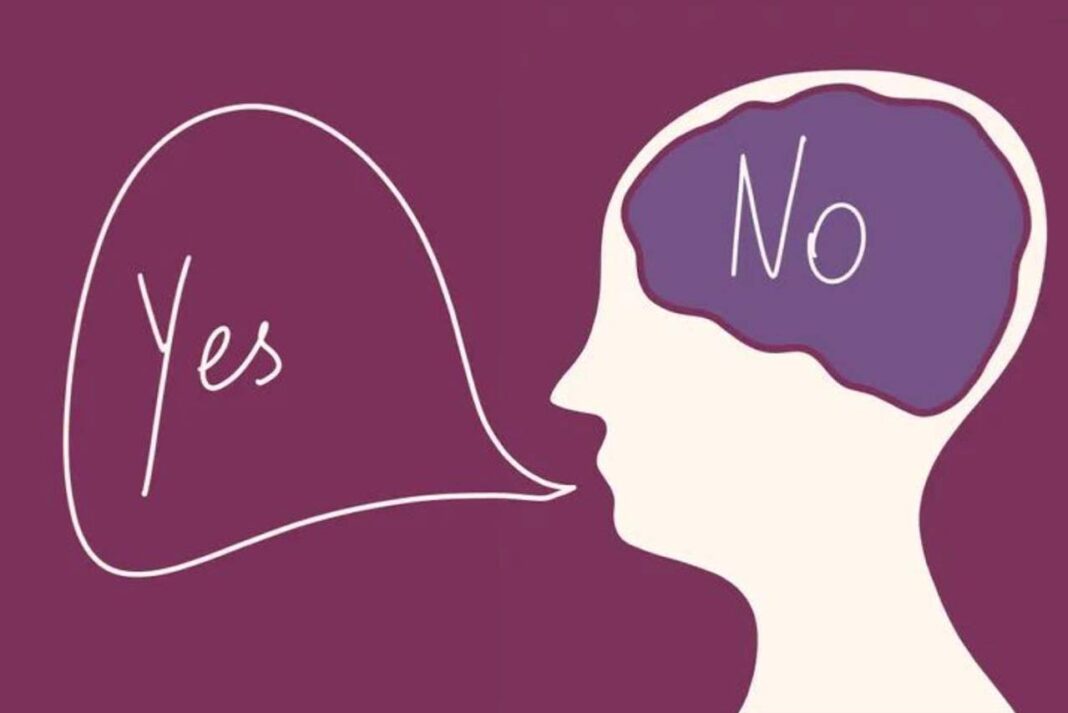

How many times have you broken yourself to avoid breaking someone else?
For some individuals, saying “no” is not merely a communicative choice; it is experienced as a threat that places the nervous system on immediate alert. Even before the intention to set a boundary is articulated, the body responds: the stomach tightens, breathing becomes shallow, and thought accelerates. Cognitively, the person may recognise their right to refuse, yet emotionally they experience the act as though they have committed a serious transgression. This contradiction reflects less a matter of moral sensitivity and more a psychopathological pattern of pathological compliance.
At this stage, the distinction between kindness and self-erasure has already been compromised. In an effort to avoid upsetting the other, the individual suspends their own boundaries—and this suspension is rarely temporary. Over time, the self becomes organised around the expectations of others. The relationship continues, conflict is minimised, yet the cost is substantial: the gradual erosion of subjective existence.
Pathological compliance is often mistaken for altruism, heightened empathy, or simply being a “good person.” Internally, however, it functions as a defence system structured around the fear of abandonment. The inability to say “no” is not a personality trait; it is more accurately understood as a learned survival strategy. And like all survival strategies, once the context shifts, it begins to produce destructive outcomes.
An Invisible Contract: Comply to Survive
Experiencing “no” as guilt-ridden—or even as an existential threat—frequently traces back to early developmental periods, long before language had fully formed. In childhood environments where love and safety were contingent upon compliance, suppressed needs, or the regulation of others’ emotional states, the nervous system internalises a silent rule:
Compliance equals attachment.
Boundaries equal loss.
For the child, this is not a conscious decision but a survival reflex. In adulthood, when this reflex becomes entangled with a rigid superego structure, any attempt at boundary-setting evokes intense existential guilt. This guilt is disproportionate to the present moment because it does not belong to the here and now; it belongs to earlier attachment threats. In such cases, “no” ceases to function as a simple refusal and instead operates as an alarm signal, activating the brain’s most primitive fear circuits.
This configuration is commonly associated with anxious-dependent or disorganised attachment patterns. Preserving the relationship takes precedence over maintaining a coherent sense of self. In order to prevent rupture, the self is placed on hold.
The Neuropsychopathology of the “No” Moment
At the moment a boundary is set, the amygdala codes the situation as a social threat. This heightened activation temporarily weakens the regulatory capacity of the prefrontal cortex. As a result, even when individuals know they are justified, they experience the act as though they have done something wrong. It is for this reason that those with patterns of pathological compliance often find themselves returning to the question, “Did I overreact?” immediately after asserting a boundary.
In some cases, this moment does not resolve into either a “yes” or a “no,” but into a freeze response. Speech halts, action becomes impossible, and self-blame follows. This is not passivity so much as a traumatic nervous system response to overload. Consequently, individuals may interpret their inability to set boundaries as evidence of weakness or inadequacy, when in fact what has occurred is not a failure of will but a collapse in self-regulation.
The issue, then, is not the content of the boundary itself, but the body’s alarm response. In attempting to appease the other, the individual is, in effect, attempting to regulate their own neurobiological distress.
The Hidden Cost Paid by the Body
Pathological compliance is not solely a psychological phenomenon; the body carries its burden continuously. The threat of social exclusion activates the anterior cingulate cortex in a manner comparable to physical pain. Each unspoken “no” finds expression somatically—as chronic muscle tension, gastrointestinal disturbances, shortness of breath, or persistent fatigue without a clear medical explanation.
When personal needs are consistently suppressed, individuals gradually lose access to bodily signals altogether. While appearing functional and accommodating externally, a quiet mourning unfolds internally: the grief of a self that can no longer be reached. As the external world remains orderly, the self is laid to rest in silence.
A Dark Attraction: Boundary Violators and the “Appropriate Victim” Profile
Within forensic psychology literature, one observation remains notably consistent: individuals with weak or permeable boundaries are quickly identified by those inclined toward boundary violations. The recurrent presence of individuals with narcissistic or antisocial traits in the lives of pathologically compliant people is not incidental.
Such individuals often begin with minor boundary tests—a small request, an ignored “no,” a normalised transgression. When these tests meet little resistance, violations expand. At this point, the relationship ceases to function as a mutual bond and instead becomes a structure in which power flows in one direction.
Silent Retaliation: The Shape of Suppressed Anger
In individuals who struggle to say “no,” anger does not disappear; it is merely redirected. When direct expression feels impossible, anger emerges through forgetfulness, chronic lateness, emotional withdrawal, or passive-aggressive disengagement. The individual does not consciously seek retaliation, yet suppressed aggression steadily erodes the relationship from within.
This dynamic represents a compromise between the need to remain “good” and the persistence of unacknowledged hostility. The relationship continues, but its vitality diminishes.
The Exhaustion of the False Self: High-Functioning Collapse
Winnicott’s concept of the False Self lies at the centre of pathological compliance. Externally, the individual appears agreeable, considerate, and unproblematic; internally, they accumulate a profound sense of emptiness and alienation. As authentic desires are consistently suppressed, the brain’s reward systems gradually lose responsiveness. Life ceases to be a source of pleasure and becomes a sequence of obligations to be fulfilled.
A sentence frequently heard in clinical settings captures this experience succinctly:
“I worry they won’t love me if I say no—but the more I say yes, the less I love myself.”
This, in essence, is pathological compliance.
Sacrifice or Self-Erasure?
Sacrifice strengthens when it is chosen.
Self-erasure begins when it feels compulsory.
The distinction lies in whether decisions are driven by guilt, fear, and abandonment anxiety—or by genuine agency.
Returning To One’s Own Voice: A Boundary is Not an Attack
Saying “no” is not an act of aggression; it is a declaration of existence. Although past experiences may have coded compliance as the only route to safety, the nervous system can relearn boundary-setting within secure relational contexts. A healthy bond is formed not through one self dissolving into another, but through two distinct selves recognising one another.
You do not need to dismantle your own space to make room for someone else. True contact becomes possible not when you disappear, but when you remain. To claim one’s boundaries is to offer a delayed yet essential response to a long-silenced inner self.