


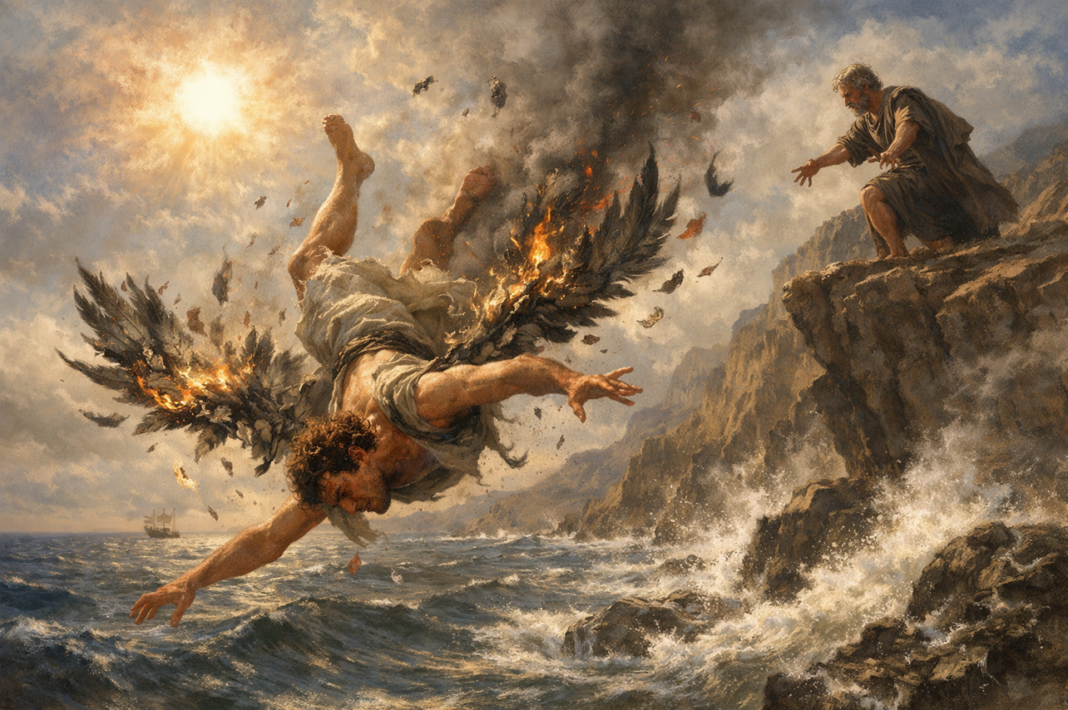

Myths are often read as narratives that offer moral lessons, teaching “right” and “wrong” behaviors through symbols. The myth of Icarus shares this fate: a young man who does not know his limits, ignores authority, oversteps his bounds, and pays the price. This reading is safe, orderly, and comforting, because it locates the error in the individual’s “excess.” Yet from a psychological perspective, this interpretation remains superficial. The real question is this: Why did Icarus have to fly so high in the first place?
Icarus is most often portrayed as a “reckless child.” He flies too high, ignores warnings, and falls. Simple, instructive, and slightly moralistic. This reading relies on a classic fairy-tale logic that preserves order: those who cross boundaries are punished, and obedience is presented as a safe harbor.
In this way, the story is reduced to an individual mistake, and responsibility is placed entirely on Icarus’ supposed “excess.” However, this interpretation misses the core of the myth. Because the issue is not merely crossing a boundary, but why that boundary became so unbearable in the first place.
From a psychological standpoint, Icarus’ tragedy has less to do with hubris than with an unmirrored self. Here, the fall is not the consequence of a moral lesson, but the inevitable breaking point of a self that has not been sufficiently regulated, seen, or relationally held. Icarus’ flight is not an act of defiance, but a final and desperate attempt to exist.
The Unmirrored Self and Grandiosity as Compensation
Kohut’s Self Psychology posits that the sense of self is formed within relationships. When a child is sufficiently mirrored by their caregivers—when they are seen, their excitement is shared, and their emotions are regulated—they develop a cohesive self. When this mirroring is insufficient, the individual clings to grandiosity to keep their fragile self intact.
At this point, grandiosity is not simple “self-admiration,” but a psychological compensation mechanism. The person must feel big because they cannot tolerate feeling small. An internal emptiness that cannot be regulated is covered up externally through exaggeration and greatness.
Icarus’ desire to fly gains its meaning precisely within this context.
Wings as a Symbol of Compensation
Icarus’ wings embody this dynamic. They are not merely a means of escape, but an attempt to transcend an incomplete, insecure, and dependent self. Remaining on the ground is synonymous for him with ordinariness, limitation, and inadequacy. Flying becomes the only way to approach a sense of wholeness.
“Staying on the ground” is not a physical position but a psychological one. To be grounded means to be limited, dependent, and in need of others. For an unmirrored self, this is intolerable. Therefore, rising upward becomes not just a desired goal but an existential necessity.
Daedalus: A Competent But Une empathic Selfobject
Daedalus appears in the myth as a rational and cautionary figure. He provides technical knowledge, draws boundaries, and explains the danger. Yet emotionally, he is absent. He does not offer a relational presence that could regulate Icarus’ excitement, overflowing energy, or longing for limitlessness. As a result, boundaries do not become internalized structures for Icarus; they remain obstacles to be overcome.
From Kohut’s perspective, Daedalus functions like a selfobject who is competent but not empathic. He tells Icarus what to do but does not wonder why he feels the way he does. In such a context, boundaries do not create a sense of safety; instead, they transform into an authority to be challenged.
Icarus’ violation of limits is not rebellion, but the outcome of an unregulated inner overflow. The ascent toward the sun is less a conscious challenge than an uncontrolled expansion of the grandiose self. The aim is not risk-taking, but to reach the feeling of perfection.
Yet unmirrored grandiosity cannot be sustained. The melting of the wings by the sun symbolizes the inevitable collapse of a narcissistic structure.
The Fall as Narcissistic Collapse
This collapse is sudden and harsh. The structure is already fragile; it is merely dazzling on the surface. A similar dynamic is observed in clinical practice: a process that appears to be going “very well” for a long time can completely unravel following a minor disappointment. The reason is that what was operating was not resilience but compensation.
The fall is not a punishment; it is a narcissistic collapse. What follows is shame. Feelings of worthlessness, emptiness, and disintegration emerge. In clinical settings, similar patterns are frequently observed: individuals who appear extremely confident, ambitious, and boundary-defying from the outside confront intense fragility in response to even minor disappointments.
Shame occupies a central position here. Because shame is the core affect of an unmirrored self. What emerges is not the feeling of “I did something wrong,” but “I am wrong.” This is why Icarus’ fall is silent and lonely; there is no relational figure to hold him, regulate him, or make sense of the experience with him.
The Real Tragedy
From this perspective, the story of Icarus is not about excessive ambition, but about an insufficiently regulated self. Icarus does not fall because he flies too high, but because he never had a relational ground on which he could learn how to land.
And perhaps this is the most tragic aspect of the myth:
Icarus’ problem is not flying. He actually knows how to fly quite well.
What he lacks is someone with whom he could learn how to come down.
Without that, a hard landing becomes inevitable.