


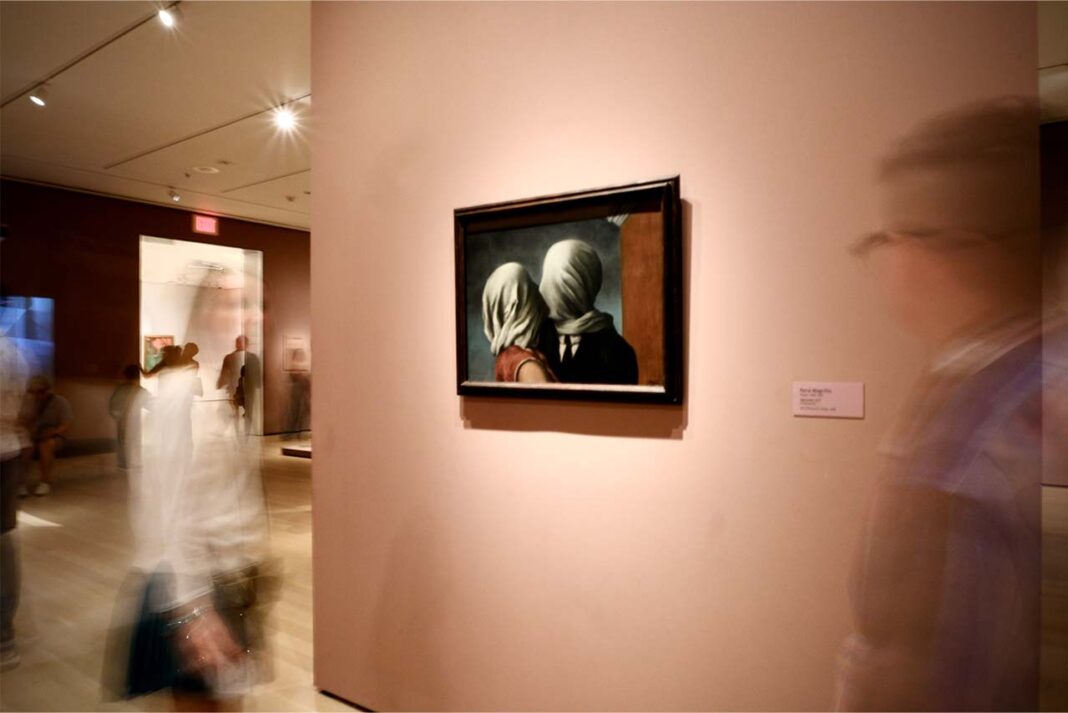

When I first saw René Magritte’s The Lovers at MoMA in New York, even though my eye read it as a scene depicting two lovers, a sense of mystery immediately arose in me. I couldn’t quite understand why their faces were covered with white cloth, what the painting was trying to suggest, or whether it hinted at lovers who can never fully reach one another, or something more unsettling. Still, I felt that the work held a meaning directed toward me, something subtle and unresolved that invited me to pause, pay attention, and return to it with deeper thought.
The research I did later showed that this initial intuitive unease was not a coincidence. Many art historians connect the possible psychodynamic symbolism behind The Lovers to Magritte’s childhood, especially to the tragic death of his mother in 1912. When Magritte was thirteen, his mother Régina Magritte died by suicide, throwing herself into a river, and her body was found days later. The evidence about the moment of death is not entirely clear. In some accounts, it is said that when the body was pulled from the water, her nightgown was covering her face, while in other accounts, it is stated that the face was covered with a cloth afterward. Even this uncertainty suggests why the event’s impact on the artist’s unconscious could have been so powerful. Still, the prevailing view in art history is that Magritte’s repeated return in later years to figures with covered faces may be an abstract echo of this childhood trauma.
Of course, Magritte himself never confirmed this theory. In fact, he was known to explicitly reject biographical readings. Nevertheless, psychoanalytic art historians argue that this very rejection may be consistent with the way traumatic experiences are processed in the unconscious and transformed into symbolic images rather than direct narrative. As the art historian David Sylvester also points out, the motif of covering faces ceases to be a simple game of form in Magritte’s world and settles at the center of his recurring symbolic language. For this reason, the motif can be evaluated less as “telling a biographical story” than as an unresolved experience returning over the years, reshaped each time.
The Psychology Of Intimacy: What Stands Between Two Lovers
When I noticed this connection, Irvin Yalom’s Momma and the Meaning of Life immediately came to mind. In his book, Yalom reveals the traces of themes such as intimacy, loss, the mother figure, and transference in his own life. In particular, he suggests that ambivalent feelings toward his mother such as both need and anger, both admiration and shame, function like a recurring motif in the background of the relationships he forms as a therapist.
In Yalom’s approach, he draws attention to the fact that the healing power is often in the relationship rather than in techniques (“It’s the relationship that heals”). For this reason, he focuses therapy on the “here and now,” which means the living, real-time relationship established between the client and the therapist. The bond the client forms with the therapist becomes an area that shows how the emotional patterns established with the first caregiver in childhood, most often the mother, are restaged in adulthood.
For Yalom, our capacity to love and be loved is closely related to the invisible relationship language learned in those early bonds being replayed again and again on different stages. For this reason, while The Lovers (1928) depicts two covered figures kissing, it can be read as a visual metaphor for the idea Yalom points to: “the past seeping into the relationship.” When the painting is viewed from this frame, the cloth covering the faces turns into a concrete image of mother-based transference, the dynamics of loss and death, and the invisible psychodynamic curtain between love and fear.
Magritte’s early encounter with his mother’s suicide and the persistent circulation of the story that her face was found veiled suggests that the idea of death, particularly death intertwined with the absence of the mother, may have left a deep and lasting imprint on his psyche. In this light, the cloth becomes more than a simple covering. It transforms into a sign inseparable from the very notion of losing; a symbol of trauma, loss, and existential loneliness.
Seen this way, the fact that both lovers’ faces are shrouded by the same fabric evokes a powerful tension between intimacy and fear. Intimacy is a human need, yet it is also frightening because it opens the possibility of being hurt, of being abandoned, of losing. Viewed from this perspective, the bodies leaning toward one another express a longing for closeness, while the cloth smothering their faces embodies the fear of loss, the possibility of being wounded, and the ultimate loneliness that intimacy could eventually bring.
At the center of Yalom’s psychotherapy approach is the idea that the relationships an individual forms in adulthood reconstruct emotional patterns determined by the first attachment figure in childhood. This mechanism of transference means that, in a close bond with another person, we actually relive the emotional depths, breaks, and fears from our own past.
From this viewpoint, The Lovers makes it possible to interpret the two covered figures not merely as an aesthetic surrealist scene, but as two people carrying the weight of their relational past in their bodies. The white cloth bears the heaviness of early caregiving experiences (being seen, being affirmed, being rejected) as it seeps into the relationship: the lovers move toward each other, yet the invisible burden of their pasts forms a distinct boundary between them.
The invisibility of the faces does not only conceal identity; it also symbolizes an inability to fully “see” one another. While true intimacy is possible when two people can bear witness to each other’s existence, in this painting even the act of witnessing encounters an obstacle.
The meaning the covering motif gains here is further strengthened by Yalom’s thoughts on death anxiety and existential loneliness. Yalom says that no matter how close our relationships are, at the deepest level of life we carry an unavoidable loneliness: no one can live in our place, and no one can die in our place. This reality does not lessen the value of relationships; rather, it makes them more fragile and more meaningful, because love always contains the possibility of loss. The white cloth in The Lovers embodies precisely this tension a sense of emotional distance and threat simultaneous with physical closeness.
Love, Courage, and Vulnerability
Finally, the white cloth can be thought of not only as an element that blocks or carries the past, but also as a binding sign that brings the two figures together in a shared vulnerability. One of the reasons this painting awakened something powerful in me is the possibility that both sides carry the shadow of their pasts and, because of traumas, cannot fully “merge” even if they draw close.
Even if fear of losing and the theme of loss stand at the center of the image, the fact that the two lovers still sustain this relationship tells me something about courage. Not everyone is brave enough to love and be loved; even if the weight of all these motifs is felt at the unconscious level, the fact that it remains there as an obstacle they still try to overcome is one of the most valuable aspects of human life.
All of us have our broken places, relational losses, and habits; the real strength is being able to pass through them and truly touch another soul. As Erich Fromm said, “Love is the only rational and satisfying answer to the problem of human existence.”
References
Yalom, Irvin D. Momma and the Meaning of Life. New York: Basic Books, 1999.
Yalom, Irvin D. Love’s Executioner and Other Tales of Psychotherapy. New York: Basic Books, 1989.
Sylvester, David. Magritte. London: Thames & Hudson, 1992.
Fromm, Erich. The Art of Loving. New York: Harper & Row, 1956.
Figure Note
Figure 1. René Magritte, The Lovers (1928), MoMA, New York. Photograph by İnci Elif Erdin.