



A few years ago, during a preschool observation, I watched three children playing and saw their pretend-play scene fall apart spectacularly. They were staging a rescue mission: one knight, one witch, one princess. But when it came time for the princess to be saved, she crossed her arms and announced, “I don’t want to be rescued. I’m busy doing science.” The knight protested. The witch accused her of “ruining the story.” Within seconds, the trio was deep in a heated negotiation about power, fairness, and who gets to decide the rules of the world they had built only moments before. And then something remarkable happened. They began negotiating. They debated what made the game fun for everyone and devised new rules. Moments later, they rewrote the story and plunged back into the game, this time with a scientist-princess who solved problems alongside the knight and witch.
Scenes like this unfold thousands of times a day in classrooms and playgrounds. Adults often see them as dramatic, messy, and conflict-heavy, assuming the arguments signal trouble or poor social skills. But to developmental psychologists, these tense moments during pretend play can be an engine of social learning. Research increasingly shows that the conflicts inside imaginary worlds may be exactly what help children practice perspective taking, emotion regulation, and collaboration.
What Is Pretend Play?
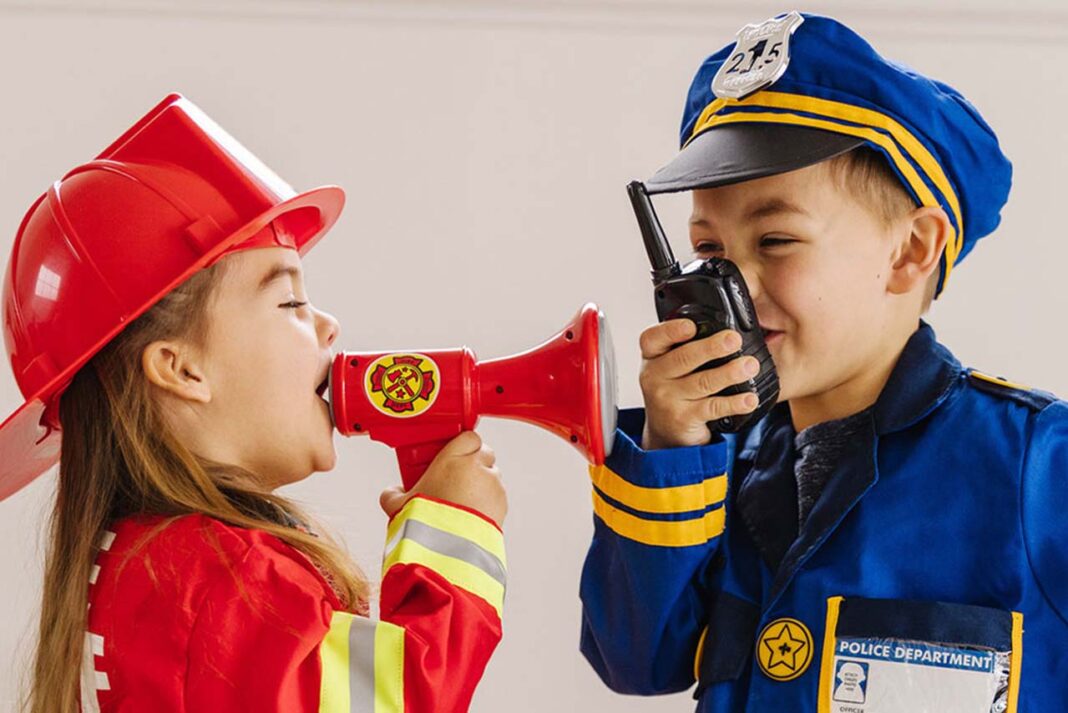
Pretend Play is any activity in which children step into a world of their own creation, where they assign new meanings to objects and take on roles. Smits-van der Nat and colleagues (2024) describe pretend play as involving five core elements: object substitutions (one thing stands in for another), attributing pretend properties (the floor is lava; the doll is sick), role enactment (becoming a character), social interaction within the imagined scenario, and meta-communication about the pretense (“Let’s pretend you’re the teacher now”).
Pretend play can happen alone, but as children get older it increasingly occurs with peers. Social pretend play creates a space where children practice understanding different perspectives, regulating emotions, negotiating rules, and resolving conflict.
Quality Matters More Than Quantity
A new meta-analysis by Mireille Smits-van der Nat and colleagues (2024) pulled together 34 studies on pretend play and social competence in children ages three to eight. They found a small but reliable relation between pretend play and social competence. Children who engage in more or richer pretend play tend to show better emotion regulation, demonstrate more prosocial behavior, have a stronger understanding of social situations, and communicate more effectively with peers.
Importantly, quality matters more than quantity. Simply spending time in pretend play doesn’t guarantee social benefits. What predicts social skills is the complexity of the play and the collaborative negotiation that happens inside it.
The association was strongest in early childhood. Younger children (around three to five) showed the clearest links between pretend play and social competence, suggesting that imaginative play may be especially important during this developmental period.
Fantasy Orientation And The Social Mind
Pretend play is connected to children’s broader fantasy orientation: the ability to engage in fantastical thinking or imagine scenarios “that violate known physical principles” (Woolley, 1997). Research by Pierucci and colleagues (2013) found that children with stronger fantasy engagement often show better executive functions, including inhibitory control and cognitive flexibility. These are the mental skills that help children pause, shift perspectives, and adapt to new rules that become essential during peer conflict.
Fantasy also shapes empathy later in life. A large-scale study of over 10,000 adults by Paulus (2024) found that people who become emotionally absorbed in fictional characters tend to score higher on empathic concern. This fantasy-based empathy declines with age, especially for women, suggesting that imaginative capacities may be most powerful early on.
Why fantasy supports the Social Brain is simple: when children imagine themselves into different roles and storylines, they practice shifting viewpoints, feeling with others, and navigating social tensions. Imagination becomes a rehearsal space for real life.
How Adults Can Support Pretend Play
How adults join (or avoid) children’s pretend play matters greatly for how rich that play becomes. Gaviria-Loaiza and colleagues (2017) describe a spectrum of adult roles. On one end are more hands-off approaches: observing from a distance, stepping in only for safety, or setting up materials and themes without joining the story.
On the other end are more active roles: entering the game as minor characters or gently guiding the narrative by introducing new ideas, vocabulary, or twists that deepen the play. Research consistently shows that when adults join the play without taking control, they support richer, more cooperative pretend play.
Pretend Play As An Engine For Social Learning
Pretend play may look chaotic. It may involve arguments about who gets to be which character or disagreements about the storyline. But those negotiations are moments when children learn how to understand one another, manage emotions, and build a shared world. Pretend play opens the door to negotiation, compromise, and more complex social understanding.
From the perspective of Developmental Psychology, pretend play is not a distraction from learning but one of its most powerful forms.
References
Gaviria-Loaiza, J., Han, M., Vu, J. A., & Hustedt, J. (2017). Children’s responses to different types of teacher involvement during free play. Journal of Childhood Studies, 4–19.
Paulus, C. M. (2024). Is fantasy an affective or cognitive part of empathy? An analysis of the fantasy scale in empathy research. International Journal of Recent Scientific Research, 15(11), 5067–5073.
Pierucci, J. M., O’Brien, C. T., McInnis, M. A., Gilpin, A. T., & Barber, A. B. (2014). Fantasy orientation constructs and related executive function development in preschool. International Journal of Behavioral Development, 38(1), 62–69.
Smits-van der Nat, M., van der Wilt, F., Meeter, M., & van der Veen, C. (2024). The value of pretend play for social competence in early childhood: A meta-analysis. Educational Psychology Review, 36(2), 46.
Woolley, J. D. (1997). Thinking about fantasy: Are children fundamentally different thinkers and believers from adults? Child Development, 68(6), 991–1011.