


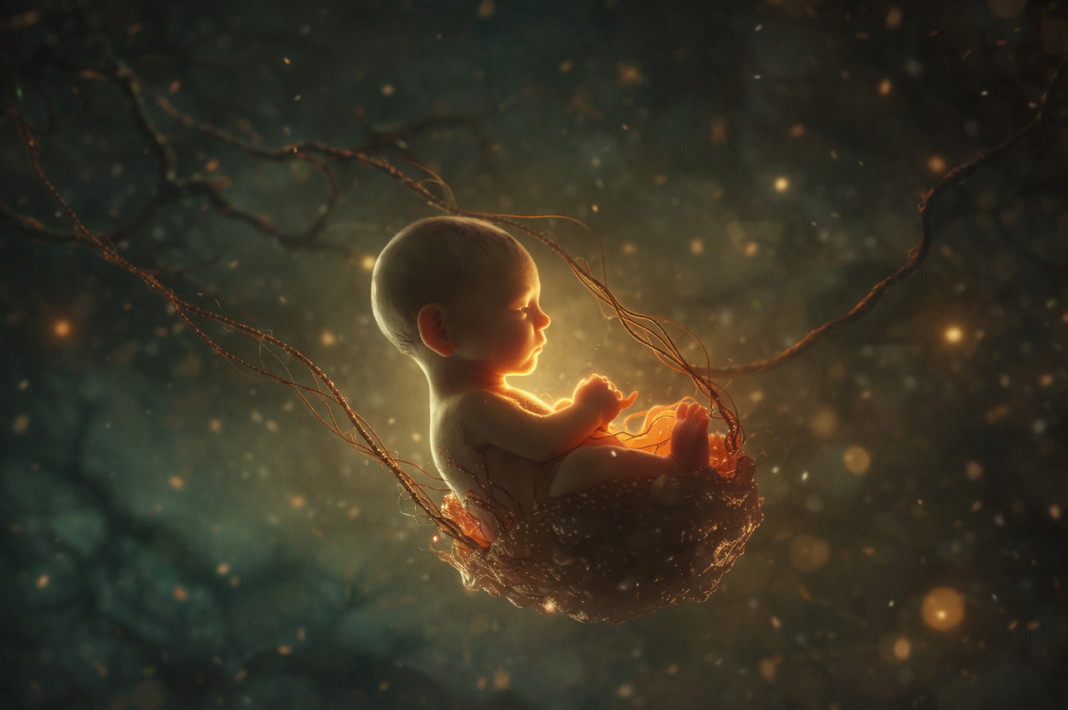

In this article, the term ‘mother’ refers to the person who carries the pregnancy and physiologically shapes the intrauterine experience. The concept addresses this situation biologically. Is a baby truly a blank slate when it is born? Or does its story begin to be written before its first breath? Life in the womb is not only a process of physical development, but also a period when senses and certain emotional traces begin to develop. So, do babies feel everything while in the womb?
The Sensory World Of The Fetus: When And What Does It Feel?
The baby is not in darkness in the womb; it is in a world surrounded by rhythm and sound. The sense of touch begins at 7–8 weeks. The development of the sense of touch does not mean that the fetus consciously perceives the world; it indicates that the basic reflex circuits of the nervous system have begun to function. The auditory system begins to develop at 18–20 weeks. The mother’s heartbeat and tone of voice create a stable and acoustic environment within the womb. Examples such as newborns being able to sleep comfortably to acoustic and repetitive sounds, like the sound of a broom, are considered a sensory and physiological sense of familiarity rather than an ‘intrauterine moment’. The response to the mother’s voice increases at 25–28 weeks. Some studies have shown that the fetus can become accustomed to certain sound patterns and responds to those sound patterns in a more organized way after birth.
Can A Mother’s Emotions Be Passed On To Her Baby?
A mother’s heartbeat provides a stable rhythm in the uterus. However, changes in heart rate during stress are quite noticeable in the uterus. In this case, the increase in cortisol due to the mother’s stress reaches the fetus via the placenta. Prolonged and intense stress can affect fetal development, but short-term emotional changes do not constitute ‘trauma’ and do not leave a lasting effect on the fetus. The statement that every sadness experienced by expectant mothers harms the baby is not scientifically sound; what matters is how the process unfolds and the level of chronic, intense stress experienced.
Is There Memory In The Womb?
A baby in the womb is exposed to many sounds, vibrations, and movements. Along with all these sounds, it also hears the voices of the expectant mother and many others from outside, but the strongest sound reaching the baby is the mother’s voice. The calming effect babies have after hearing their caregiver’s voice after birth shows that they had a great deal of contact with this voice in the womb. The stress, excitement, and positive and negative emotional changes that the mother experiences during pregnancy have a significant impact on the fetus’s hormonal and brain development. Stress is a human emotion and a state of strain felt as a result of pressure. While this is quite natural, excessive stress can be very harmful. Even when individuals receive good news, such situations can cause stress. Considering that fetuses become one with their mothers in the womb in terms of soul, body, and mind, and taking into account the fetus’s reactions to the sounds it hears inside after birth, there is a very high probability that babies may turn into restless, disorganized, and excessively crying babies. In this context, the mother and everyone around her should guide the pregnancy process by considering both their own emotional state and hormones, as well as the baby’s cognitive, mental, and emotional development.
The First Foundations Of Emotional Bonding
Perhaps the first stage of trust begins with listening to a heartbeat. A baby in the womb does not experience the world in the way we perceive it; however, the mother’s body is its first environment. The mother’s stress levels, hormones, and physiological rhythms can shape the environment within the womb, and the fetus can respond biologically to these changes according to its own developmental capacity. However, this does not mean that every emotion of the mother determines the baby’s fate. During this long process leading up to birth, it should be considered that the mother and her environment need to approach the process as sensitively as possible. It is important not to overlook the fact that a woman, in addition to her own organs, is growing an individual in her womb and can be affected physically and psychologically at every point. The relationship between mother and baby is not a one-way transfer; it is a constantly adapting, delicate, and dynamic biological dialogue. Perhaps the first contact of a human being with the world begins precisely here, in this silent reciprocal interaction that starts even before birth. Babies do not know the world in the womb; But they recognize the rhythm, the sound, and the biological environment. The memory in the womb is not a memory book; it’s more like a starting point.
References
-
Hepper, P. G. (1991). An examination of fetal learning before and after birth. The Irish Journal of Psychology, 12(2), 95–107.
-
Kisilevsky, B. S., Hains, S. M. J., Brown, C. A., Lee, K., Cowperthwaite, B., Stutzman, S. S., Swansburg, M. L., Lee, D., & Xie, X. (2003). Fetal sensitivity to properties of maternal speech and language. Infant Behavior and Development, 26(4), 507–519. https://doi.org/10.1016/j.infbeh.2003.08.002