


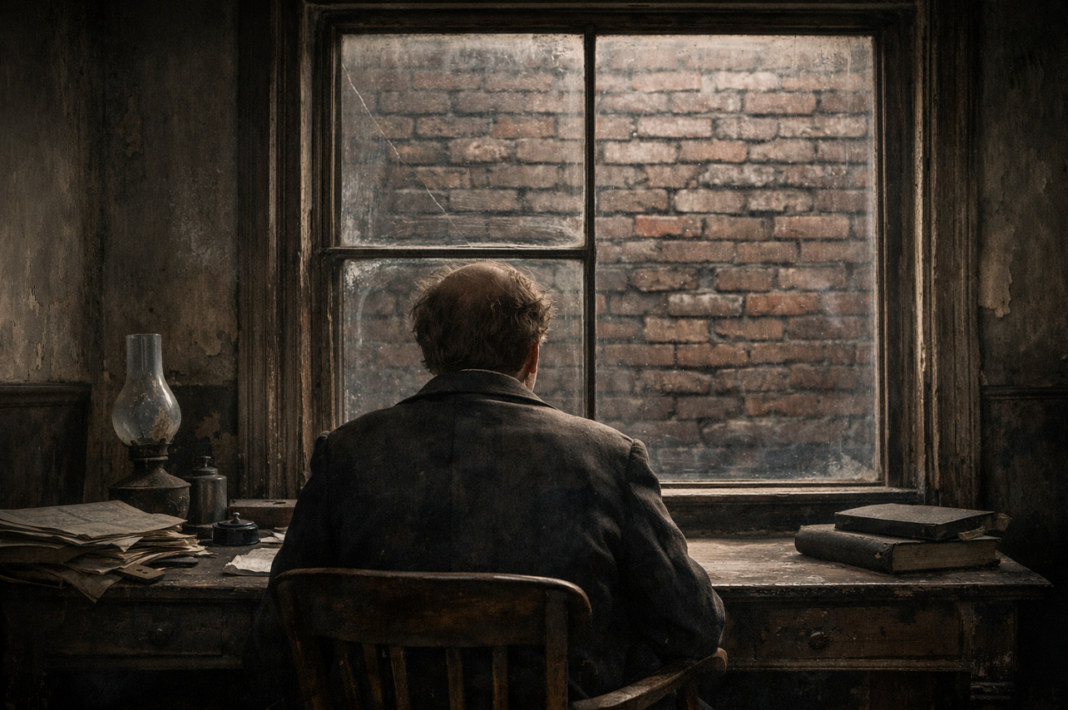

Consider Herman Melville’s Bartleby, the Scrivener. This quiet, unassuming person suddenly utters the famous sentence: “I would prefer not to.” He ceases his work, withdrawing quietly from life, movement, and contact with the living beings around him. He spends his days staring at a brick wall through an empty, faded window. But is this merely a stubborn renunciation? Or is it the silent cry of a weary, sensitive soul who interprets life as a heavy and complex burden?
We have all stood before that window and looked at that wall at times. Because when we are afraid, when we don’t feel safe, or when we are burdened with more than we can bear, we build invisible walls between ourselves and life. This is a natural, understandable need for refuge.
Maps Of Fear That Conceal The Truth
The author Jorge Luis Borges tells the story of those who draw a giant map, the exact same size as the world. So much so that, over time, this enormous map replaces reality, and the actual world it depicts is forgotten. Anxiety does exactly that to us. The terrifying map we construct in our minds freezes life, obscuring creativity and meaning. We no longer observe what simply is, but rather watch that enclosed room where our own fears echo.
Psychiatrist and trauma specialist Bessel van der Kolk explains that every sentient being who perceives the world as a dangerous place “freezes” at that final point where they can neither fight nor escape. Our bodies, in a way, switch off to protect us from pain. Therefore, those thick walls we build, our withdrawal into ourselves, or our “choosing not to do” like Bartleby, are not flaws to be judged. On the contrary, they are the self-protective efforts of someone afraid of being hurt. Bartleby’s words are, in fact, the silent cry of a weary nervous system saying, “If I take a step, if I make contact, I won’t be safe.”
Not Washing Away Tar With Tar: Coming To The Safe Shore Of The Body
So, how do we overcome this wall that separates us from the outside world, from the flow of life, and from each other?
Trying to resolve fear, anxiety, and that state of paralysis within our minds—using thoughts and new constructs—is like adding fuel to the fire. Indeed, our minds created that terrifying simulation themselves. Trying to overcome anxiety by thinking is like trying to wash away tar with tar. As neuroscientist Stephen Porges often reminds us, we cannot transform fear with logic and words alone. The solution is to leave behind the noise of thoughts for that moment and come to our bodies, to the “present moment.” It’s not complicated; it is simple.
Feeling our feet on the ground, being aware of our breathing, feeling the coolness of the air on our skin… These are our first bodily anchors, emerging from the dark construct of the mind and stepping into life. As the tension in our shoulders lessens and our bodies calm down, the huge brick wall that our minds have built around us begins to crack and thin.
Breaking Free From Fictions And Reconnecting
Anxiety loves to write disaster scenarios. It is often the weight of these scenarios that keeps us from connecting. When we are about to take a new step or intend to connect, an inner voice might immediately say, “Something bad is definitely going to happen, you’ll get hurt.” Yet, this is often just a story. When we gently peel away these heavy, catastrophic labels we have attached to events with our own fears, only a simple moment remains. Light.
Every living thing that breathes, feels, and vibrates needs to connect with another. While isolation may make us feel temporarily safe, healing only begins when we reconnect. Engaging with life requires stepping out of that cold, supposedly safe room we have closed ourselves off in.
From Pink Floyd’s Stage To Life: Breaking Down The Wall Brick By Brick
We don’t need massive, perfect, and grand moves to break down the imaginary wall around us, to escape that state of stagnation. Trying to take very big steps only frightens us more and freezes us again. All we need is to take the smallest, simplest step we can at that moment. To begin…
In 2013, I was at Roger Waters’ The Wall concert in Istanbul. On stage, I watched firsthand how that enormous wall was first built brick by brick, and then how it was demolished by their own hands, with small, gentle blows. I understand that moment much better now as I recount it. The demolition of that artificial, cumbersome wall we have erected between ourselves and others happens not with one big, angry move, but with patient, compassionate, and small steps. In that shared space that opens up, we can finally touch each other’s reality.
Turning your face toward the sun, gently touching a living being you love, simply taking a sip of water with awareness, or being able to say “I need help” to someone… Life only begins when we gently put down those heavy burdens and courageously reconnect with the world and with each other. If now isn’t the right time to thin down the walls we have built around ourselves and reconnect with life, if there is no “now” closer than that tiny step we are about to take, then when?
Bibliography
-
Borges, J. L. (2004). A universal history of iniquity (A. Hurley, Trans.). Penguin Classics.
-
Melville, H. (2026). Bartleby, the scrivener. Vintage Classics.
-
Porges, S. W. (2011). The polyvagal theory: Neurophysiological foundations of emotions, attachment, communication, and self-regulation. W. W. Norton & Company.
-
Van der Kolk, B. A. (2014). The body keeps the score: Brain, mind, and body in the healing of trauma. Viking.
-
Waters, R. (2013, August 4). The wall live [Concert]. ITU Stadium, Istanbul, Turkey.